Tanabata: The Night Japan Wishes Upon the Stars — and How to Bring That Wonder to Your Garden
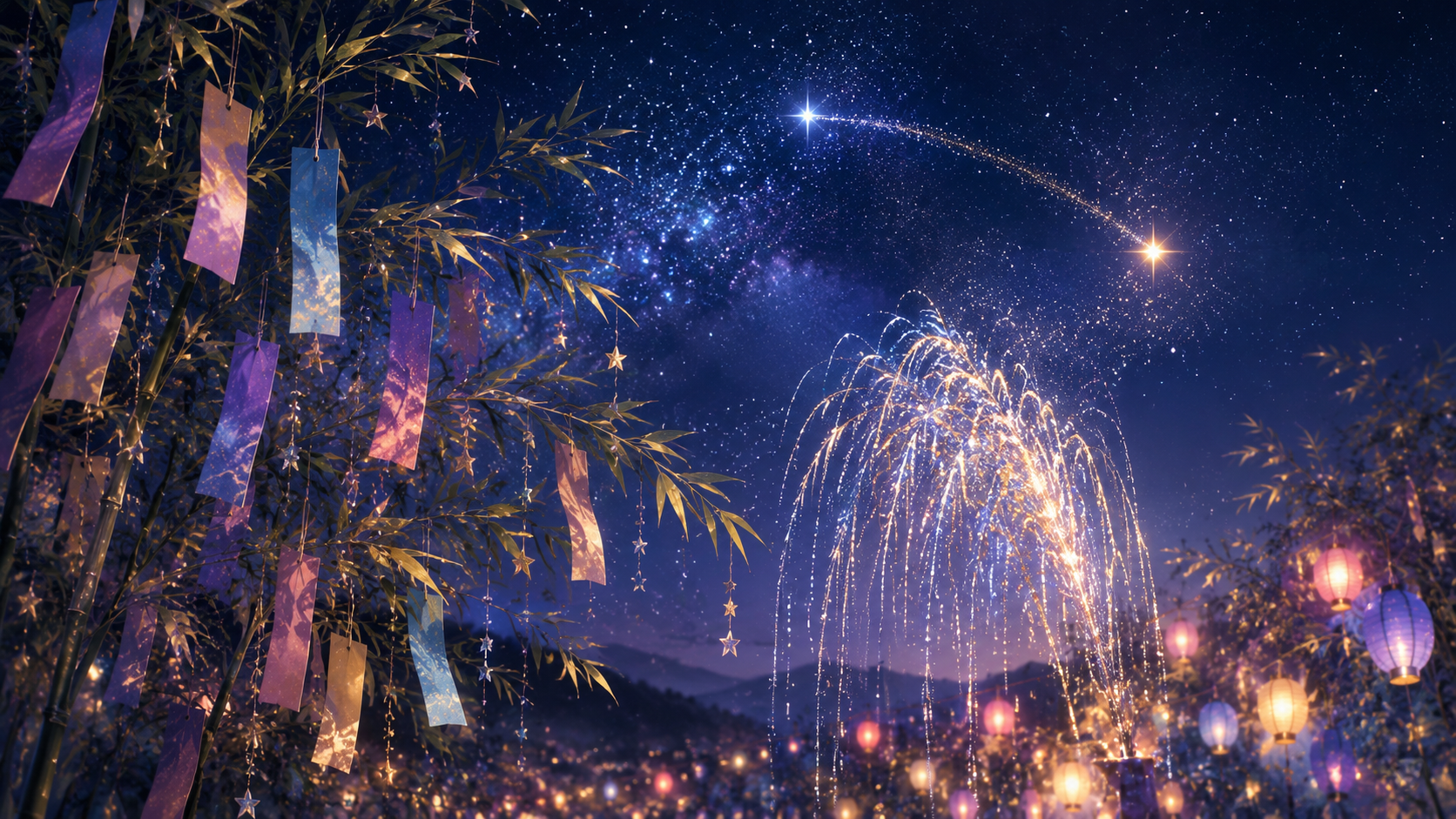
Once a year, on the seventh day of the seventh month, Japan looks up.
Across the country, streets bloom with paper streamers in every colour imaginable. Bamboo branches bow under the weight of thousands of handwritten wishes. And as darkness falls, the sky itself becomes the stage — because Tanabata, the Star Festival, is a celebration written in starlight.
At Galaxy Fireworks, we’ve spent more than three decades helping people turn ordinary evenings into something unforgettable. And few festivals capture what we love about fireworks quite like Tanabata: light, longing, and a little bit of magic overhead.
The Legend of the Two Stars
Every great festival begins with a story, and Tanabata’s is one of the most romantic ever told.
High in the heavens lived Orihime, the weaver princess — the star we know as Vega. She wove beautiful cloth on the banks of the Amanogawa, the “heavenly river” that we call the Milky Way. Across that river lived Hikoboshi, the cowherd — the star Altair.
When the two met, they fell so deeply in love that Orihime abandoned her loom and Hikoboshi let his cattle wander the heavens. Orihime’s father, the Sky King, was furious. He separated the lovers, placing them on opposite banks of the Milky Way, forbidden to meet.
But Orihime’s tears moved him. He granted the couple one night a year — the seventh night of the seventh month — when a bridge of magpies would form across the celestial river and the two stars could be reunited.
Look up on a clear July evening and you can see them yourself: Vega and Altair, two of the brightest stars in the summer sky, separated by the pale ribbon of the Milky Way. On Tanabata night, the whole of Japan wishes them well.
Wishes on Bamboo
The heart of Tanabata isn’t just the legend — it’s what people do with it.
In the days leading up to the festival, families write their wishes on small strips of coloured paper called tanzaku. Children wish to become better at handwriting or football; adults wish for health, love, and good fortune. Each wish is tied to the branches of fresh-cut bamboo, chosen because it grows straight and tall, carrying hopes toward the sky.
By festival day, whole streets shimmer with bamboo dressed in fluttering paper — reds, golds, blues and greens dancing in the summer breeze. In cities like Sendai, home to Japan’s most famous Tanabata celebration, enormous streamers several metres long hang from every arcade, transforming shopping streets into tunnels of colour.
There’s something wonderfully universal about it. Who among us hasn’t looked at a summer night sky and made a quiet wish?
When the Sky Answers Back: Japan’s Tanabata Fireworks
And then, as evening falls, Japan does what Japan does best: it fills the sky with fire.
Tanabata season marks the opening of Japan’s legendary summer fireworks calendar. Great festivals light up rivers and bays across the country, with tens of thousands of shells blossoming over the water — golden willows that hang in the air like falling stars, chrysanthemums that bloom and fade in a heartbeat, and cascades of silver that seem to pour the Milky Way itself down toward the crowds below.
Japanese firework artistry — hanabi, literally “fire flowers” — is considered among the finest in the world. Families spread picnic blankets along riverbanks, dressed in light summer yukata, and watch the sky tell the story of the two reunited stars in bursts of gold and silver.
It’s a reminder of something we believe passionately here at Galaxy Fireworks: fireworks aren’t just noise and spectacle. At their best, they’re storytelling. They’re wonder, shared.