Liberty, Equality, Fireworks: The Story of Bastille Day
Liberty, Equality, Fireworks: The Story of Bastille Day
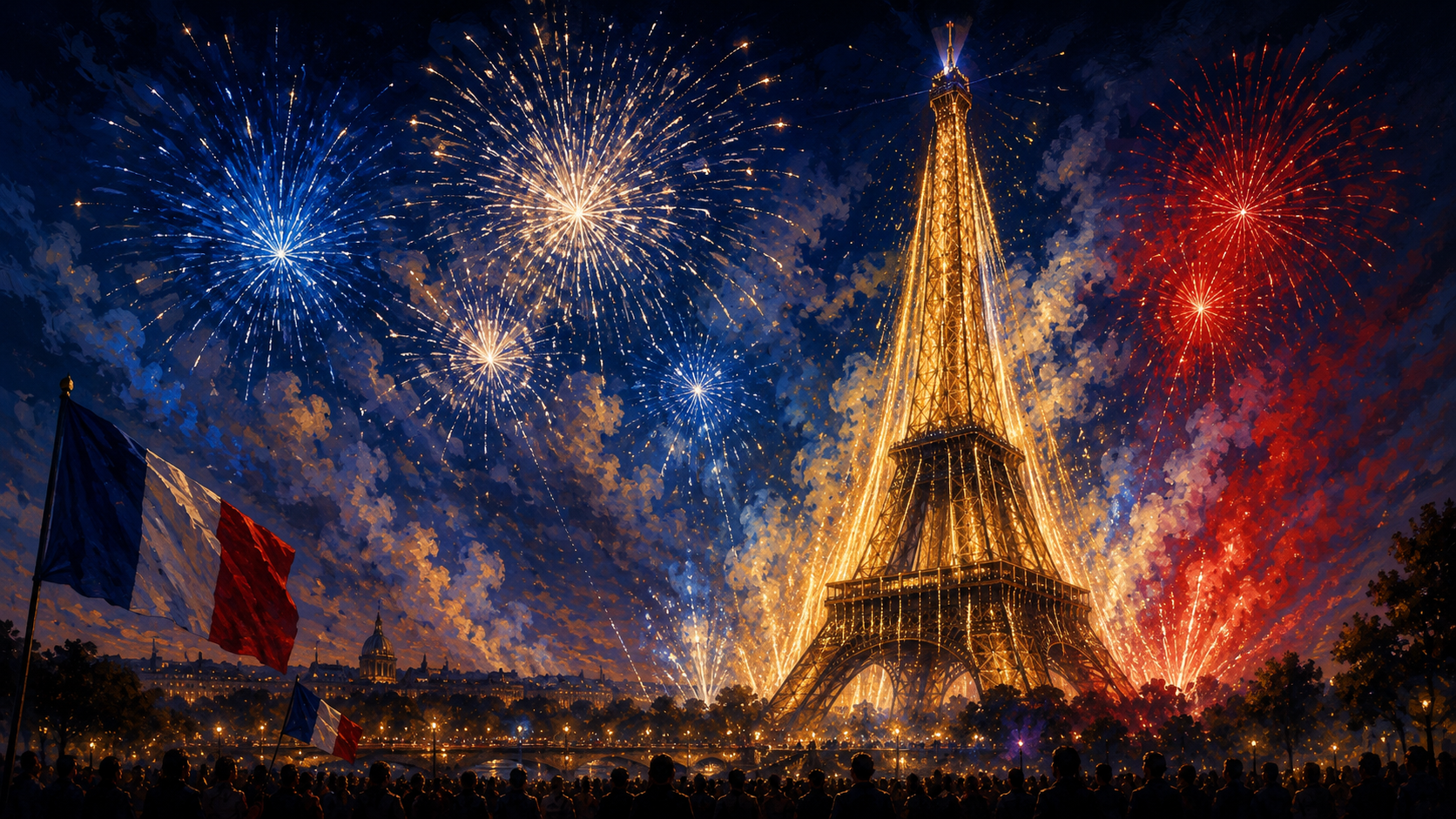
On the evening of 14 July each year, the Eiffel Tower disappears. Not literally — but for a few glorious minutes, its iron silhouette is swallowed whole by fire, colour, and smoke, as one of the most famous fireworks displays on Earth erupts across the Paris skyline. It’s a spectacle watched by millions, both on the banks of the Seine and on screens around the world. But behind the fireworks lies a story of revolution, defiance, and the birth of a nation’s identity — a story worth telling before the first rocket ever leaves the ground.
The Day That Changed France Forever
To understand Bastille Day, you have to go back to a Paris boiling with tension. By the summer of 1789, France was a kingdom in crisis. Decades of lavish royal spending, crushing taxation on the poor, and a rigid class system had pushed ordinary citizens to breaking point. Bread prices had soared, the treasury was empty, and King Louis XVI’s grip on power was slipping.
On 14 July 1789, that pressure finally exploded. A crowd of Parisian citizens, desperate for weapons and gunpowder to defend their newly formed National Assembly, marched on the Bastille — a towering medieval fortress and prison that had long stood as a symbol of royal tyranny and absolute power. After a tense and bloody standoff, the fortress fell. Its governor was killed, its gates thrown open, and its prisoners freed.
In truth, the Bastille held only seven prisoners that day — hardly the mass liberation of legend. But the symbolism was seismic. The storming of the Bastille represented ordinary people rising up against centuries of unchecked royal power, and it is widely regarded as the spark that ignited the French Revolution — a decade of upheaval that would ultimately topple the monarchy, execute a king, and reshape the political landscape of Europe forever.
From Revolution to National Holiday
The date wasn’t officially adopted as France’s national day until nearly a century later, in 1880, when the young Third Republic sought a unifying symbol of French identity. Rather than commemorate the storming itself — a day still associated with violence — the date was cleverly tied to the Fête de la Fédération of 14 July 1790, a celebration held one year after the Bastille’s fall, where citizens from across France gathered on the Champ de Mars to swear loyalty not to a king, but to the nation, the law, and the constitution.
It was a masterstroke of national storytelling: a single date that could honour both revolutionary defiance and hard-won unity. Today, Bastille Day — known in France simply as le 14 juillet — stands for the very ideals etched into the French motto: Liberté, Égalité, Fraternité. Liberty, equality, brotherhood.
Parades, Pageantry, and Patriotism
Modern Bastille Day is a full sensory celebration of French pride. In Paris, the day begins with one of Europe’s oldest and largest military parades, marching down the Champs-Élysées in front of the President of the Republic, complete with fighter jet flypasts trailing blue, white, and red smoke across the sky.
Across the country, towns hold their own festivities — communal bals des pompiers (firefighters’ balls), open-air concerts, flag-draped town squares, and long lunches shared among neighbours. It’s a day built on collective memory, where the revolutionary spirit of 1789 is honoured not with solemnity, but with joy, food, music, and celebration.
The Eiffel Tower’s Legendary Fireworks
And then, as darkness falls, comes the moment the whole country — and much of the world — waits for. The Eiffel Tower fireworks display is widely considered one of the most spectacular pyrotechnic shows on the planet, choreographed with breathtaking precision to a live orchestral and musical score broadcast across France.
Every year brings a new theme and a new story told entirely through light — cascades of gold pouring down the tower’s iron lattice, shockwaves of colour bursting from its base, shimmering curtains of fire framing the Paris skyline. It’s a display built not just for scale, but for emotion: a nation using fire and colour to tell its own story, year after year, to a crowd that never tires of watching.
Create Your Own French-Inspired Grand Finale
You don’t need the Eiffel Tower — or a national budget — to create a fireworks moment with genuine drama and scale. That’s exactly what our Pro Barrages range was built for.
Designed for those who want serious, professional-grade impact, Pro Barrages deliver the kind of multi-effect, high-shot-count performance that defines the world’s great public displays — dense volleys of colour, powerful crackling effects, soaring comets, and thunderous finale sequences, all engineered for maximum visual and sonic impact.
Whether you’re hosting a milestone celebration, a summer garden party with genuine wow-factor, or simply want to bring a taste of that iconic Parisian grandeur to your own back garden, Pro Barrages give you the tools to build a display worthy of the occasion — bold, layered, and unmistakably spectacular.
This is fireworks displayed the way the professionals do it: with scale, precision, and a finale that leaves everyone watching in stunned silence before the applause.
Vive la Fête
Bastille Day is a reminder that some of history’s most powerful moments begin with ordinary people refusing to stay silent — and that even the darkest chapters can be honoured, generations later, with light, colour, and celebration. This 14 July, take a page from Paris’s book. Gather your crowd, raise a glass, and give the night sky a finale worth remembering.
🎆 Explore Pro Barrages now at galaxy-fireworks.co.uk/c/pro-barrages/
Liberty, equality, and one unforgettable finale.