
Firework Rocket Launch Tubes: A UK Guide to Choosing and Using Them Safely

A firework rocket launch tube that looks right still may not be suitable for your rocket. The tube guides a rocket as it leaves the ground, but it should only be used when it matches the rocket and its instructions. Check whether the pack includes launch equipment and whether the instructions specify how to use it. Don’t assume a separate tube is needed or suitable.
This guide explains what a launch tube does, what it can’t do and how to check the compatibility information provided with your rocket. It also covers how to assess the surface, surroundings and weather before setting up, so you can make decisions based on the product instructions rather than guesswork.
With more than 30 years of fireworks experience, 1st Galaxy Fireworks understands that a memorable display starts with careful preparation. We’ll cover supplied and separate tubes, the instructions to follow and practical safety considerations for using rockets responsibly. That way, you can plan with greater confidence and focus on the colour and spectacle of the display.
Key Takeaways
- Learn how firework rocket launch tubes guide a rocket’s stick whilst allowing it to move freely during launch.
- Use the rocket’s packaging and manufacturer instructions to assess compatibility. Tube dimensions alone aren’t enough.
- Compare supplied equipment, separate tubes and multi-tube products by their intended use and the guidance provided.
- Use a safety-first checklist to prepare your setup, follow the stated safety distances and keep spectators clear.
- Plan around the rockets’ instructions and the space available, so your display is well organised and responsible.
What Are Firework Rocket Launch Tubes For?
A firework rocket launch tube guides the rocket’s stick as the rocket leaves the ground. It provides a channel for the initial movement, supporting the rocket at launch whilst allowing the stick to move freely. The tube does not propel the rocket, and it cannot make an unsuitable rocket safe to use.
It helps to distinguish the main parts. The rocket motor produces thrust, the fuse initiates the rocket, and the stick helps stabilise it in flight. The tube has a narrower role: it guides the stick at the start. The Skyrocket (firework) article describes the traditional use of a stick as a stabilising feature. The launch tube guides that stick during the initial movement, rather than controlling the rocket’s flight.
That distinction matters when choosing equipment. A tube isn’t automatically suitable just because a rocket can be placed inside it. Rocket and tube combinations aren’t universally interchangeable, and the tube cannot correct a mismatch, an unstable setup or failure to follow instructions. Treat the rocket’s packaging and manufacturer guidance as the authority for how it should be launched.
How does a rocket launch tube work?
The tube acts as a guide, not a launch mechanism. As the motor propels the rocket upwards, its stick needs to move freely through the tube. If the stick catches or the rocket is obstructed, it may not leave as intended. Follow the specific instructions for the rocket and its supplied equipment. Don’t assume that a tube directs the rocket’s flight or guarantees a safe launch.
Think of the tube as one part of a planned setup, not a substitute for reading the instructions or assessing the display area. Its presence alone doesn’t establish that the rocket is compatible or that the overall arrangement is suitable.
Does every rocket need a separate launch tube?
Not necessarily. Some rockets may be supplied with launch equipment, whilst others may require a separate tube. Check the specific pack and its instructions to see what equipment is provided and how it should be used. Don’t infer what applies to an individual rocket from a general product description or from another rocket in the same range.
If the instructions call for separate equipment, use only a tube identified as suitable for that rocket. Length or diameter on its own doesn’t prove compatibility, and a tube that looks similar to the supplied one shouldn’t be treated as an approved substitute without clear manufacturer guidance. For a broader introduction to rockets and other traditional effects, explore our guide to traditional fireworks, including rockets.
How to Match a Rocket Launch Tube to the Rocket
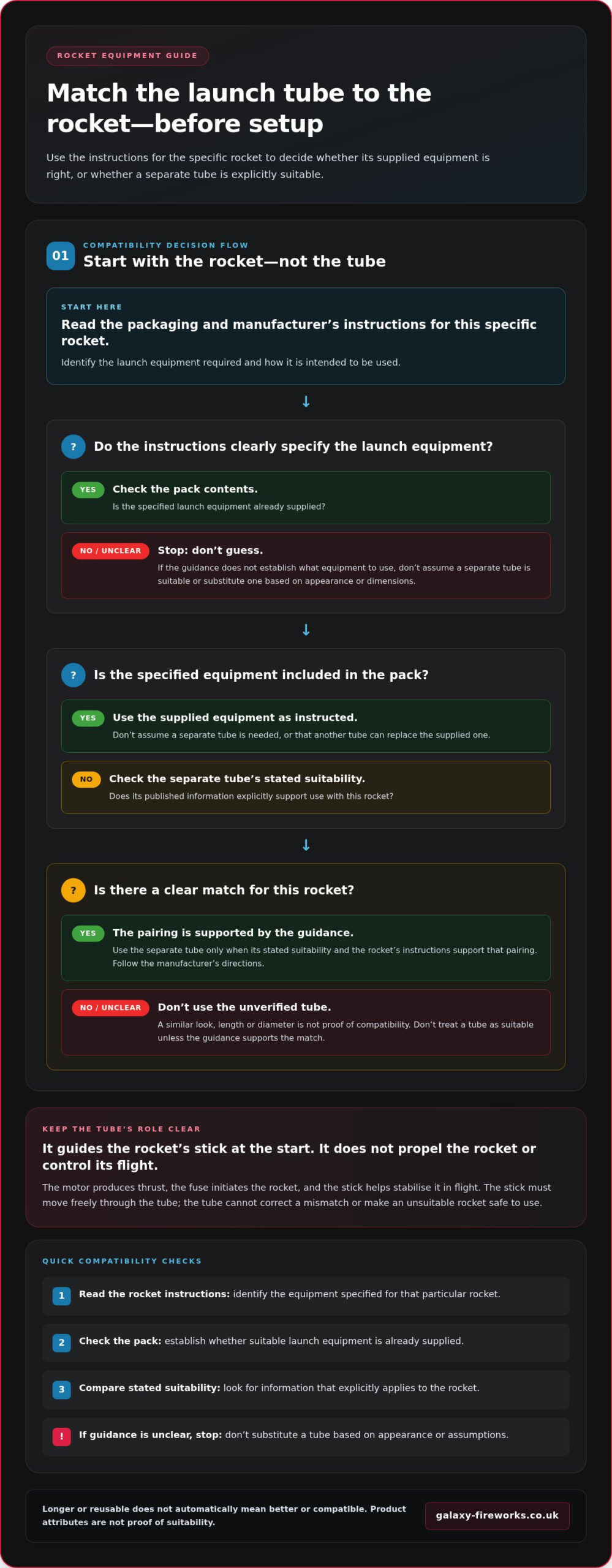
Compatibility starts with the rocket, not the tube. Read the packaging and manufacturer’s instructions for the specific rocket you plan to use. They should explain the launch equipment required and how it is intended to be used. If a pack includes equipment, don’t assume a separate tube is needed or that another tube can replace it.
Dimensions can help describe a product, but length or diameter alone can’t establish whether it’s suitable. Two tubes may look similar yet be intended for different rockets. Likewise, a tube that appears to accommodate a rocket’s guide stick isn’t automatically compatible. Avoid drawing conclusions from appearance or from a retailer’s example for another product.
Which compatibility details should you check?
Compare the rocket’s instructions with the tube’s published suitability information. Look for a clear match for the rocket or the relevant type of rocket, and check whether the pack already supplies launch equipment. If the information doesn’t support the combination, don’t treat a similar size or shape as proof. The UK Fireworks Law guidance covers wider legal requirements for fireworks. Compatibility must be determined from the product instructions.
Before selecting separate equipment, use this short checklist:
- Read the rocket instructions. Identify the launch equipment specified for that particular rocket.
- Check the pack contents. Establish whether suitable launch equipment is already supplied.
- Compare stated suitability. Look for information that explicitly applies to the rocket, rather than relying on dimensions alone.
- Stop if guidance is unclear. Don’t substitute a tube based on appearance or assumptions.
Are reusable or longer tubes always better?
No. Material, length and reusability are product attributes, not safety guarantees or proof of compatibility. A longer tube isn’t automatically better, and reusable equipment isn’t automatically suitable for every rocket. Compare published specifications only when they apply to the rocket you intend to launch, and follow the manufacturer’s directions over general descriptions.
For example, a product listing might state a tube’s length and material, but those details alone don’t say which rocket it suits. A separate tube is a reasonable choice only when its stated suitability and the rocket’s instructions support that pairing. Don’t adapt the combination or substitute equipment against the guidance. If the instructions don’t establish a match, use the equipment specified for the rocket instead.
Checking the details before planning your display helps prevent a common mistake: treating one tube’s specifications as a universal standard. Once you’ve settled on rockets and their specified equipment, explore the rocket selection and use each product’s guidance to check what you’ll need.
Choosing Between a Supplied Tube and Separate Rocket Launch Tubes
The right choice depends on the rocket and the display you’re planning, not simply on how many tubes an arrangement has. A supplied tube may be intended for a particular rocket, whilst a separate tube or multi-tube product may be designed for a specific use. Treat each as matched equipment: read the rocket and tube instructions together, and don’t assume one arrangement suits every rocket.
Use this comparison to organise the information provided with the products. It isn’t a substitute for that guidance. If a detail isn’t given, record it as “not stated” rather than filling the gap with an assumption.
| Option | Intended use | Compatibility guidance | Equipment and dimensions |
|---|---|---|---|
| Supplied launch equipment | Use with the rocket or pack it accompanies, as directed. | Follow the rocket’s instructions and any stated restrictions. | Whether equipment is supplied: included with that pack. Dimensions: check the product details. |
| Separate tube | Use only for a rocket it is stated to suit. | Look for a clear compatibility match in the tube and rocket instructions. | Whether equipment is supplied: not applicable to a separate tube. Dimensions: check published specifications. |
| Multi-tube product | Use for the arrangement described by its manufacturer. | Check that the guidance covers the rockets and any firing method involved. | Number of tubes and dimensions: check the product details; otherwise, not stated. |
When might separate launch tubes be relevant?
A separate tube may be relevant when the rocket’s instructions call for it and the tube’s information identifies that rocket as suitable. A multi-tube arrangement may be designed for a particular display configuration, but that doesn’t make it suitable for other rockets or combinations. Even when a product mentions a firing system, follow the instructions for that specific product and don’t assume the system applies to other equipment.
Before deciding, check the rocket’s pack and the tube’s instructions side by side. Confirm what the rocket requires, what the tube is intended for and whether the planned arrangement follows both sets of directions. If they don’t clearly support the pairing, don’t proceed based on appearance or convenience alone.
What should a comparison table include?
Keep the comparison factual. Record stated compatibility, dimensions where published, whether the rocket pack includes launch equipment and any limits on the intended arrangement. Mark product details that aren’t provided as “not stated”. That makes gaps visible and avoids turning one product’s dimensions into a general standard for all firework rocket launch tubes.
A table can help you compare options, but it can’t establish that the display site is suitable. For broader planning principles, consult the HSE Fireworks Safety Guidance alongside the instructions for your fireworks. Once you know which rockets and equipment your plan calls for, explore the rocket selection with those requirements in mind.
Safe Setup: What to Consider Before Using a Rocket Launch Tube
A suitable tube is only one part of a safe rocket setup. The site, surface and conditions on the day must also allow you to follow the firework’s instructions as written. Use this checklist as a planning aid, not a replacement for the product guidance. If you can’t meet its requirements, don’t improvise or proceed.
What should you assess at the launch site?
Start by checking the instructions for the required setup, safety distance and any site restrictions. Then consider whether the chosen position and ground allow you to follow those directions. A surface that shifts, slopes or won’t support the arrangement described in the instructions may make the location unsuitable. Don’t try to solve that by changing the tube or inventing a way to hold it in place.
Check the surroundings too. Keep people, pets, buildings, trees and other obstacles clear in line with the product guidance. Consider wind before the display and watch for changes. If conditions could affect the instructed setup or the clear area, pause and reassess. A location that seemed suitable earlier may no longer be appropriate.
Before proceeding, check:
- Instructions: Are the setup and stated safety distances clear, and can you follow them?
- Surface: Does the ground support the arrangement described for this rocket?
- Clearance: Can people, pets and obstacles remain outside the required area?
- Conditions: Do wind or other changes make the planned setup unsuitable?
- Equipment: Is the launch tube being used exactly as directed, without alteration?
Why avoid improvised racks and tube modifications?
A homemade rack or altered tube may not suit a particular consumer firework, even if it appears stable or convenient. Changing equipment can also mean the setup no longer follows the manufacturer’s directions. Don’t cut, reshape or combine launch equipment, or rely on a homemade arrangement to make an unsuitable site work. If the instructed setup isn’t possible, don’t proceed with that rocket.
Good planning means treating the product instructions as the starting point, then checking that the location and conditions support them. For broader advice on planning responsibly, see our UK firework safety guide. This additional guidance can help you think through the wider display, but it doesn’t override the instructions for your specific firework.
Take the same careful approach when choosing what to launch. Explore our rocket selection and plan around the equipment and safety guidance provided for the rockets you choose.
Plan Your Rocket Display with the Right Equipment and Guidance
A well-planned rocket display begins with choosing rockets that suit the event and the space available. Then follow the instructions for each rocket, including what launch equipment is supplied and how it should be used. This order keeps decisions practical: don’t select firework rocket launch tubes first and assume they’ll suit whichever rockets you choose later.
Think about the whole display, not just the launch point. The available area needs to accommodate the setup and the safety distances stated for the fireworks, with spectators kept clear as instructed. If the space, surface or conditions don’t allow you to follow the product guidance, reconsider the plan rather than trying to make the equipment fit.
A practical checklist before choosing rockets
Before buying, match the planned effect to the event and consider who will prepare the display. A manageable plan is easier to organise and gives you time to check each product’s requirements.
- Consider the event and space. Assess the available display area and whether it can accommodate the rockets’ stated setup and safety distances.
- Think about who will set up. Make sure the people responsible can understand and follow the instructions provided for the fireworks.
- Read the packaging before purchase. Review the rocket’s directions, required equipment and safety information so you know what the planned display involves.
- Check what is included. Establish whether launch equipment comes with the rocket and follow the instructions for that specific pack.
- Keep the plan manageable. Choose a display that suits the site and can be prepared in line with current UK guidance.
Once you’ve chosen your rockets, keep their packaging and instructions available for planning and setup. Don’t treat one rocket’s equipment requirements as a rule for the rest of the display. Each product’s own guidance should inform your decisions about its launch equipment and placement.
Where to go next for rocket guidance
1st Galaxy Fireworks has more than 30 years of experience in fireworks, and its online shop includes rockets for consumers. Use the information provided with the rockets you select to understand their intended use and equipment requirements. General product information can help you compare options, but the individual rocket’s instructions remain your guide for setup and use.
Give yourself time to review those details alongside the site and safety guidance before display night. If a rocket’s requirements don’t fit the available space or the people setting up can’t follow its instructions, choose a more suitable plan rather than improvising. Careful preparation helps keep the focus on enjoying the colour and spectacle responsibly.
Ready to plan your display? Explore the rocket selection and use each product’s guidance to choose equipment and prepare with care.
Make Your Next Display a Confident One
The best preparation is a plan you can follow calmly on the day. Before committing to a display, consider whether the rockets, their specified equipment and the available space all work together. If a detail doesn’t fit, adjust the plan rather than forcing a solution. That thoughtful approach leaves more room to enjoy the anticipation and the brilliant colours overhead.
As you browse, let each rocket’s product information shape your decisions about firework rocket launch tubes and setup. 1st Galaxy Fireworks draws on more than 30 years of industry experience, with rockets available through its UK online shop. Take a considered look at the options, then keep the relevant instructions close as you plan. Explore rockets at 1st Galaxy Fireworks and start shaping a display for your occasion. With a little care and a clear plan, you can look forward to a memorable celebration.
Frequently Asked Questions
What is a firework rocket launch tube?
A firework rocket launch tube is a guide that supports the rocket’s stick as the rocket begins its launch. It isn’t the motor that produces the thrust, and it doesn’t steer or control the rocket in flight. Some packs include launch equipment, so check the contents and directions for the rocket you’ve chosen. Use the tube only as instructed for that product, rather than assuming it suits other rockets.
Can I use any launch tube with any firework rocket?
No. A tube that looks like the right size isn’t necessarily suitable. Compare the compatibility information on the tube with the rocket’s packaging and directions, including whether the combination is explicitly supported. For example, equipment intended for one rocket shouldn’t be assumed to suit another simply because their sticks appear similar. If the instructions don’t establish how to use them together, don’t try the pairing or improvise a setup.
Do rockets come with launch tubes?
Some rocket packs include launch equipment, whilst others may have different requirements. Before planning a display, check the individual product description and the packaging that comes with the rocket. Note what equipment is included and any instructions for its use. Don’t assume that every pack contains a tube, or that equipment supplied with one rocket can be transferred to another. The specific product directions should guide your preparations.
Can you use a rocket launch tube on hard ground?
That depends on the setup instructions for the particular rocket and the conditions at the site. A method that works for one product shouldn’t be treated as suitable for another. Don’t add makeshift supports or alter the tube to get around unsuitable ground. If the available surface prevents you from following the manufacturer’s directions as written, don’t use that arrangement. Reconsider the location or the display plan.
Are reusable firework rocket launch tubes safe to use?
Reusability alone doesn’t establish that a tube is suitable for a rocket or ready for use. Read its directions, confirm that the rocket’s instructions support the pairing, and inspect the equipment for damage before relying on it. Don’t use a tube that can’t be set up as instructed, and don’t modify it to make it fit. Follow the rocket’s own safety guidance for every use.
Can wind affect a firework rocket launch?
Yes. Wind can change conditions around the display, so assess the site before setting up and follow the firework’s weather guidance. A launch tube can’t compensate for weather or a launch area that the instructions make unsuitable. If you can’t follow the product guidance under the conditions on the day, postpone rather than attempting to adjust the equipment or carry on with an improvised arrangement.
How do I know whether a rocket launch tube is stable enough?
Follow the setup directions supplied for the rocket and tube, then consider whether the chosen site allows that exact setup. Don’t judge stability only by whether the tube looks upright when empty. The instructions, equipment and surface all matter. Avoid makeshift supports or modifications. If you can’t achieve the instructed arrangement, don’t launch from it. Recheck the product safety information and choose a plan you can follow as directed.
