Firework Safety Tips UK: Complete 2026 Display Guide
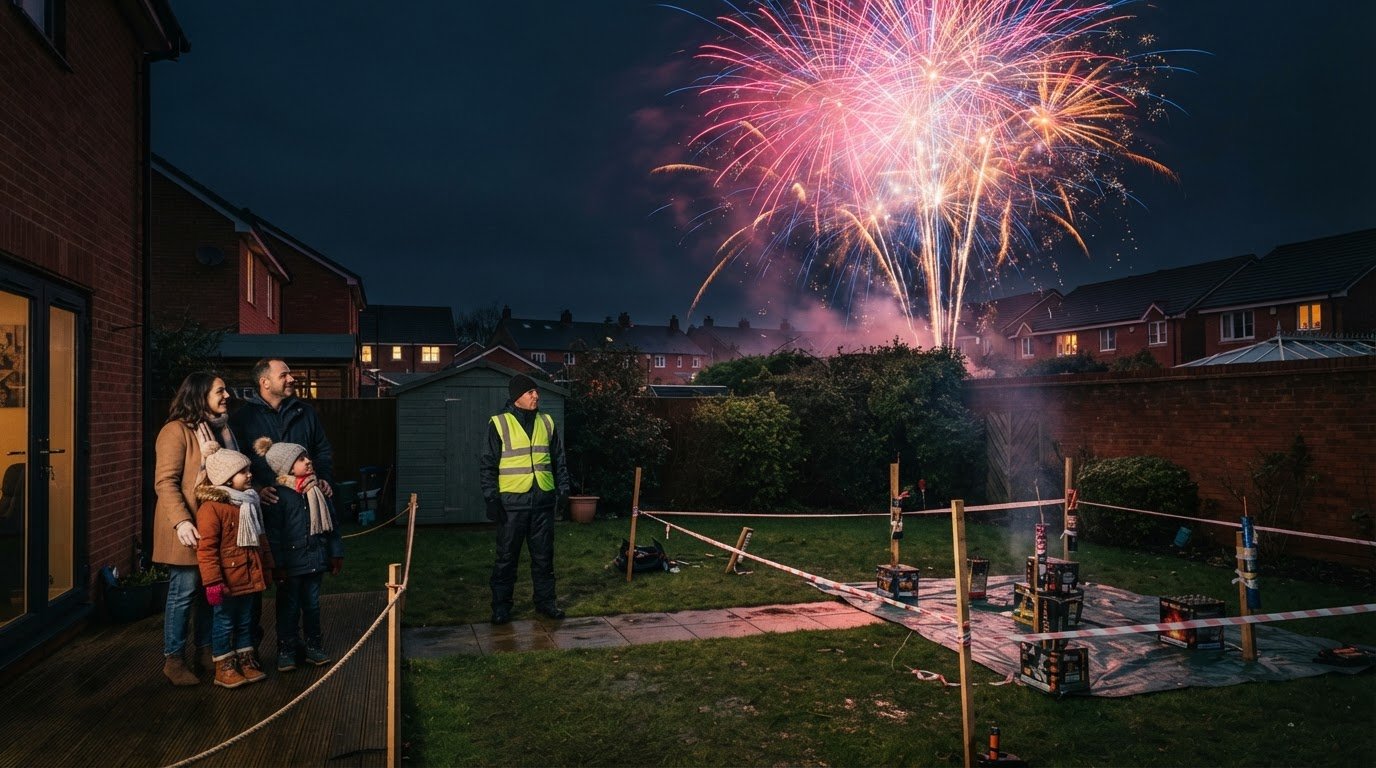
Spectacular home displays rely on methodical pyrotechnic preparation rather than luck. When you’re planning a celebration in your garden, the genuine fear of accidental burns, damaged property, or falling foul of statutory curfews can easily overshadow the excitement. It’s completely natural to feel cautious when managing live pyrotechnics around family and neighbours. Mastering the core firework safety tips UK regulations and display specialists recommend is the single most effective way to replace that anxiety with genuine confidence, ensuring your celebration remains both breathtaking and entirely safe.
This comprehensive guide will show you how to design and execute a flawless backyard show from initial site layout to final cleanup. You’ll discover legal clearance distances for Category F2 and F3 fireworks, reliable staking techniques to keep heavy cake barrages grounded, statutory firing curfews across Great Britain, and exact misfire disposal protocols so you can deliver an unforgettable visual showcase with complete peace of mind.
Key Takeaways
- Master essential firework safety tips UK regulations require, including statutory curfews and mandatory clearance distances for Category F2 and F3 items.
- Establish three distinct garden zones for firing, spectating, and fallout to eliminate stray debris risks before lighting your first fuse.
- Discover proven rigging techniques using wooden stakes and heavy-duty tape to ensure single ignition barrages and cakes remain perfectly upright.
- Implement strict post-display misfire protocols, including mandatory waiting times and overnight water soaking procedures for complete safety.
- Protect neighbouring pets, livestock, and vulnerable individuals through proactive communication and considerate display scheduling.
UK Firework Laws and Classifications: What You Must Know
Staging an impressive display at home begins with understanding the legal framework governing retail pyrotechnics. Complying with the Fireworks Act 2003 and the Fireworks Regulations 2004 isn’t just about avoiding substantial fines; it forms the foundation of responsible display management. All consumer pyrotechnics sold across Great Britain must carry verified UKCA or CE markings, confirming they meet strict manufacturing tolerances. As part of essential firework safety tips UK organisers must follow, matching your firing site to the appropriate legal classification ensures everyone remains protected while enjoying the spectacle.
Understanding Firework Categories: F1 to F4
Pyrotechnic devices fall into distinct categories based on their hazard levels, explosive net mass, and acoustic output. Reviewing foundational pyrotechnic classifications and mechanics makes it easier to appreciate why different devices require substantially different operating buffers:
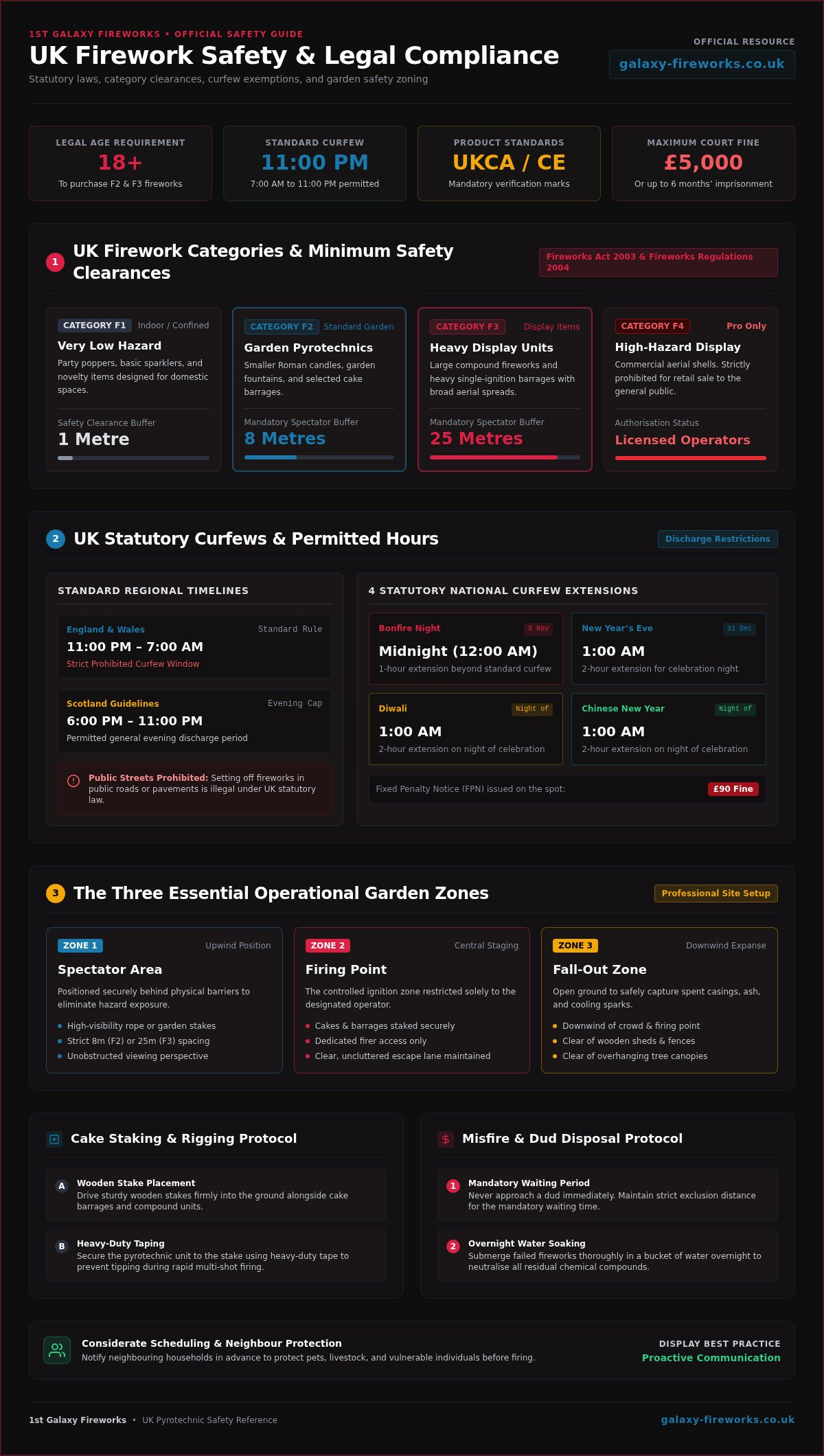
- Category F1: Very low-hazard items intended for confined indoor spaces or domestic gardens, such as party poppers and basic sparklers, requiring a minimal 1-metre safety clearance.
- Category F2: Standard garden fireworks, including smaller Roman candles, fountains, and selected cake barrages. These demand a strictly enforced 8-metre minimum spectator buffer.
- Category F3: Powerful display fireworks, encompassing larger compound units and heavy single ignition barrages. These generate significant aerial spreads and legally require at least a 25-metre spectator buffer.
- Category F4: High-hazard professional display fireworks. These items are strictly prohibited for public retail sale and can only be purchased and fired by licensed display operators.
UK Curfew Rules, Age Limits, and Legal Penalties
Under statutory UK law, purchasing Category F2 and F3 items requires proof of age, restricting sales strictly to individuals aged 18 and over. Firing hours are equally rigid. Standard regulations prohibit setting off fireworks between 11:00 PM and 7:00 AM across England and Wales, while Scottish guidelines cap general evening discharges between 6:00 PM and 11:00 PM.
National exemptions grant specific extensions for four annual cultural events:
- Bonfire Night (5 November): The curfew is extended until midnight (12:00 AM).
- New Year’s Eve (31 December): Displays are permitted until 1:00 AM.
- Diwali: Firing is permitted until 1:00 AM on the night of celebration.
- Chinese New Year: Firing is permitted until 1:00 AM on the night of celebration.
Disregarding these hours or setting off items in public streets carries serious consequences. Police can issue on-the-spot £90 Fixed Penalty Notices, with court convictions yielding fines up to £5,000 or up to six months’ imprisonment. Respecting statutory boundaries guarantees a seamless celebration for your guests without disrupting the wider community.
Planning Your Firing Site: Clearances, Layout, and Weather
Transforming your garden into a private launch venue requires an eye for detail before buying any pyro. While standard safety campaigns focus entirely on hazards, professional display operators know that thorough layout planning is what makes an evening truly exhilarating. Assessing your garden boundaries early ensures you select the right cake barrages and fountains to suit your available space. Checking official guidance on UK fireworks laws and curfew restrictions confirms your display remains fully compliant, letting you focus on producing a polished, memorable show for your guests.
Establishing Safe Firing Zones and Spectator Barriers
Professional choreographers divide every venue into three strict operational areas to manage risk smoothly:
- The Spectator Area: Positioned behind high-visibility rope or garden stakes, keeping guests safely back from ignition zones.
- The Firing Point: The central staging ground where cakes and single ignition barrages are secured; this zone remains strictly restricted to the designated firer.
- The Fall-Out Zone: An open, clear expanse situated downwind of both the firing line and audience, designed to catch spent cardboard casings and cooling sparks safely away from wooden sheds, overhanging tree canopies, or neighbouring roofs.
Always maintain an unobstructed escape lane leading away from the firing ground. If unexpected ground drift occurs, the firer needs an immediate, clutter-free exit route.
Managing Wind Speed, Rain, and Poor Weather
British weather demands tactical flexibility. Ground wind dictates where sparks and smoke travel, meaning your layout must adjust based on live conditions on the night. If sustained wind speeds or erratic gusts exceed 20 mph, call off the display immediately; high winds cause aerial bursts to drift unpredictably into adjacent properties.
Rain doesn’t have to ruin your evening. You can keep fuse assemblies completely dry by wrapping cake barrages in standard plastic bags or clingfilm during afternoon rigging. When you’re ready to light the show, simply slice open the plastic directly above the fuse and launch tubes. For homeowners seeking an effortless garden event with fewer individual setups, choosing pre-packaged discounted display packs streamlines your site layout while delivering spectacular visual impact. Applying these proven firework safety tips UK specialists rely on guarantees a fluid, professional performance whatever the autumn skies bring.
Safe Firing Protocols: Staking, Rigging, and Lighting
Methodical physical preparation turns a good display into a seamless, professional-grade performance. Many domestic accidents happen simply because firing units shift during ignition or rockets are launched from makeshift holders. Opting for single ignition barrages provides the safest route to an uninterrupted aerial spectacle, reducing your physical exposure to a single lighting event. Following established HSE display planning and safety guidelines protects the firer and audience from the moment the first fuse is uncovered.
Securing Barrages and Rocket Launch Tubes
Modern cake barrages possess powerful internal recoil that can cause an unsecured unit to pivot or topple on uneven grass. To keep every shot firing straight into the night sky, implement these physical staking rules:
- Drive wooden stakes: Knock sturdy wooden stakes deep into the turf directly behind the cake, positioning them on the side closest to spectators.
- Tape firmly: Secure the firework casing to the stake using heavy-duty gaffer tape or high-tensile cable ties. Never drive nails or screws directly into the cardboard body.
- Stabilise on hard ground: If firing on stone or patio slabs, sandwich cakes between heavy building bricks to eliminate lateral movement.
- Clear rocket tubes: Always fire rockets from purpose-built launch tubes angled slightly away from the audience. Check that the wooden stick slides freely inside the tube before lighting; never jam sticks into the lawn or launch from glass bottles.
Lighting Techniques and Personal Protective Equipment
Operating as the designated firer requires appropriate gear and calm execution. Hands and eyes account for over half of all firework injuries, making personal protective equipment non-negotiable. Wear impact-resistant safety goggles, heavy leather rigger gloves, and outer clothing made of dense cotton or wool rather than quick-melting synthetic fabrics.
When you’re ready to ignite, stand sideways at arm’s length from the firework. Never lean your face or upper body over the top of any pyrotechnic unit while exposing the fuse. Light the tip using a specialised pyrotechnic portfire or windproof blowtorch lighter, avoiding ordinary matches or short cigarette lighters that compromise your reach. As soon as the fuse ignites, walk steadily back to your designated safety zone. Integrating these essential firework safety tips UK display veterans rely on guarantees a fluid, drama-free firing sequence from opening lift to finale.
Post-Display Safety: Misfires, Duds, and Safe Disposal
The conclusion of your finale marks the beginning of the most critical phase of the evening. According to Home Office fire statistics, fireworks-related fire incidents rose by 42% in 2024/25, with a significant portion sparked by smouldering casings discarded into household wheelie bins too early. Following disciplined post-display protocols is essential for avoiding accidental flare-ups once the audience heads inside. Adhering to the clear firework safety tips UK emergency services recommend ensures your display concludes as safely as it began.
Dealing with Dud Fireworks and Hangfires
If a firework fails to fire after lighting, treat it as a live hazard. It may be experiencing a hangfire, where an internal delay composition smoulders invisibly before igniting the main lifting charge unexpectedly:
- Enforce the 20-minute rule: Keep spectators behind safety barriers and wait a minimum of twenty minutes before stepping near a non-functioning unit.
- Never re-light a dud: Under no circumstances should you attempt to re-ignite a failed fuse or tamper with the internal tubes.
- Approach with caution: Approach the firework from the side wearing safety goggles and leather gloves. Never position your head or torso directly over the top of the barrels.
- Douse thoroughly: Soak the unit completely using a garden hosepipe or an entire bucket of water to neutralise any lingering embers.
Disposal Protocols and Site Decontamination
Spent multi-shot cakes and compound units retain intense heat within their internal cardboard tubes and pressed clay plugs long after firing. Sweep your entire garden lawn with a powerful torch to locate stray rocket sticks, plastic nose cones, and smouldering debris that may have drifted into flowerbeds or hedges.
Submerge both misfired units and spent cake bases in a water trough or bucket for twenty-four hours to saturate all unburnt powder. Keep soaking containers outdoors, positioned well away from wooden sheds, decking, or dry foliage. Once thoroughly soaked, seal the inert material into heavy-duty refuse sacks for standard domestic waste collection. If you want a trouble-free setup designed for reliable performance from start to finish, explore curated firework display packs built to strict quality standards. To prepare your next event with equipment you can trust, order your display fireworks directly from seasoned display specialists.
Protecting Pets, Neighbours, and Children During Displays
A truly successful celebration brings joy to your immediate circle without causing distress to the surrounding neighbourhood. Fireworks produce immense excitement, yet sudden sound pressure and bright flashing effects can provoke severe anxiety in domestic animals and create friction across adjoining boundaries. Integrating community awareness into your display planning ensures harmony. Practising these considerate firework safety tips UK organisers swear by keeps vulnerable family members, pets, and neighbours secure throughout the evening. If you’re coordinating an extensive community gathering where crowd control and safety clearances become complex, choosing a professional firework display provides an effortless, fully managed solution.
Pet Welfare and Neighbour Consideration
Under the Animal Welfare Act 2006, causing unnecessary suffering to domestic animals or livestock carries serious legal consequences. Concussive aerial bursts can trigger acute panic in pets, but thoughtful preparation prevents trauma:
- Notify early: Give neighbours several days’ warning alongside your intended firing window so pet owners can make comfortable arrangements.
- Walk early: Exercise dogs well before dusk settles, preventing stressful encounters with unexpected early bangs outdoors.
- Secure indoors: Keep companion animals inside with external doors, windows, and cat flaps shut tight, drawing heavy curtains to buffer visual flashes.
- Mask the sound: Build a secure den in an interior room using favourite blankets, playing soothing radio or television audio to drown out aerial thuds.
- Opt for lower noise: Incorporate colourful fountains, mines, and Roman candles to produce breathtaking visuals with gentle crackles rather than jarring reports.
Sparkler Safety Rules for Children
Sparklers are often viewed as harmless handheld novelties, yet figures from the Children’s Burns Trust revealed a fourfold surge in serious paediatric burns requiring specialist hospital admissions during 2025. A lit sparkler burns at temperatures between 1,000°C and 1,600°C; that’s hot enough to melt glass and soft metals. Enforce these strict handling protocols around younger spectators:
- Age limits: Never hand sparklers to toddlers or children under five years old.
- Protective wear: Insist that anyone handling sparklers wears thick leather gardening gloves or dense woollen mittens.
- Arm’s length: Teach children to hold sparklers horizontally at full arm’s length, maintaining plenty of space between friends without running.
- Immediate quenching: Station a metal bucket filled with cold water right beside the lighting area, dropping spent wires directly into the water to cool them instantly.
Deliver a Spectacular, Safe Garden Celebration
Running an unforgettable fireworks display comes down to thorough preparation and disciplined firing practices. By enforcing strict safety distances for Category F2 and F3 fireworks, securing cake barrages firmly against solid wooden stakes, and adhering strictly to national curfews, you can produce a dazzling show without placing spectators, pets, or property at risk. Putting these essential firework safety tips UK specialists depend on into practice ensures your celebration runs smoothly from the very first ignition to the final cleanup.
Backing your event with proven pyrotechnic expertise makes all the difference. With over 30 years of UK pyrotechnic heritage, 1st Galaxy Fireworks supplies fully tested CE and UKCA compliant pyrotechnics delivered nationwide via licensed hazardous goods couriers. Whether you need single ignition barrages for maximum simplicity or complete display packs for a coordinated garden performance, you’ll have dependable hardware supporting your vision. When you’re ready to host an extraordinary evening, explore our safe, premium UK consumer fireworks and light up the sky with absolute confidence.
Frequently Asked Questions
What are the legal distances required for fireworks in a UK garden?
Category F2 garden fireworks legally require a minimum spectator clearance distance of 8 metres, whilst larger Category F3 display fireworks demand at least 25 metres. These safety buffers are measured from the firing position directly to the front spectator line. If your garden cannot safely accommodate these boundaries, scale down your selection to smaller Category F2 items to prevent hot debris from drifting towards your guests.
Can I legally set off fireworks in my garden at any time of year?
Yes, you can legally fire consumer fireworks on private land on any day of the year, provided you adhere to statutory curfew hours and purchase from licensed sellers. While seasonal retail in general shops is restricted to defined windows, specialist pyrotechnic stockists supply fireworks year-round. Always observe core firework safety tips UK regulations specify, check for local Firework Control Zones, and give adjacent neighbours advance notice.
What should I do if a firework fails to go off?
If a firework fails to function after lighting, keep everyone behind safety barriers and wait a strict minimum of twenty minutes before cautiously approaching it. Never attempt to re-light a dud fuse. Wear protective goggles and leather gloves, approach from the side, and douse the unit thoroughly with water. Submerge the soaked casing in a bucket of water for twenty-four hours before domestic disposal.
Are sparklers considered dangerous for young children?
Sparklers pose a serious burn hazard because their metal tips reach temperatures between 1,000°C and 1,600°C, which can instantly ignite synthetic clothing or cause deep skin damage. They should never be given to children under five years old. Older children must be supervised directly, wear heavy leather gloves, hold the wire at arm’s length, and plunge spent sparklers immediately into a dedicated metal water bucket.
How do I secure a single ignition cake barrage from falling over?
Secure a cake barrage by driving a sturdy wooden stake into the ground directly behind the firework casing and strapping it tight with heavy-duty gaffer tape or zip ties. Never pierce the cardboard casing with nails or screws. If you are setting up on hard ground like patio slabs, firmly wedge the barrage between heavy concrete blocks or building bricks to eliminate tipping caused by internal recoil.
What is the firework curfew in the UK and does it have exceptions?
The standard UK curfew prohibits setting off fireworks between 11:00 PM and 7:00 AM. Exceptions apply on four specific cultural dates each year. On Bonfire Night (5 November), the cutoff extends until midnight. On New Year’s Eve, Diwali, and Chinese New Year, firing is permitted until 1:00 AM the following morning. Following these firework safety tips UK curfews enforce protects you from Fixed Penalty Notices and police sanctions.
How do I safely store fireworks at home before my event?
Store unlit fireworks inside a dry, cool, and locked location that remains completely inaccessible to children and household pets. Keep them in their original sealed transport packaging, positioned far away from open flames, electrical heaters, boilers, and combustible materials like petrol or solvents. Never store pyrotechnics in damp outdoor sheds or unheated greenhouses, as ambient moisture easily dampens fuses and degrades performance.