
5 firework distance checks for spectators and gardens
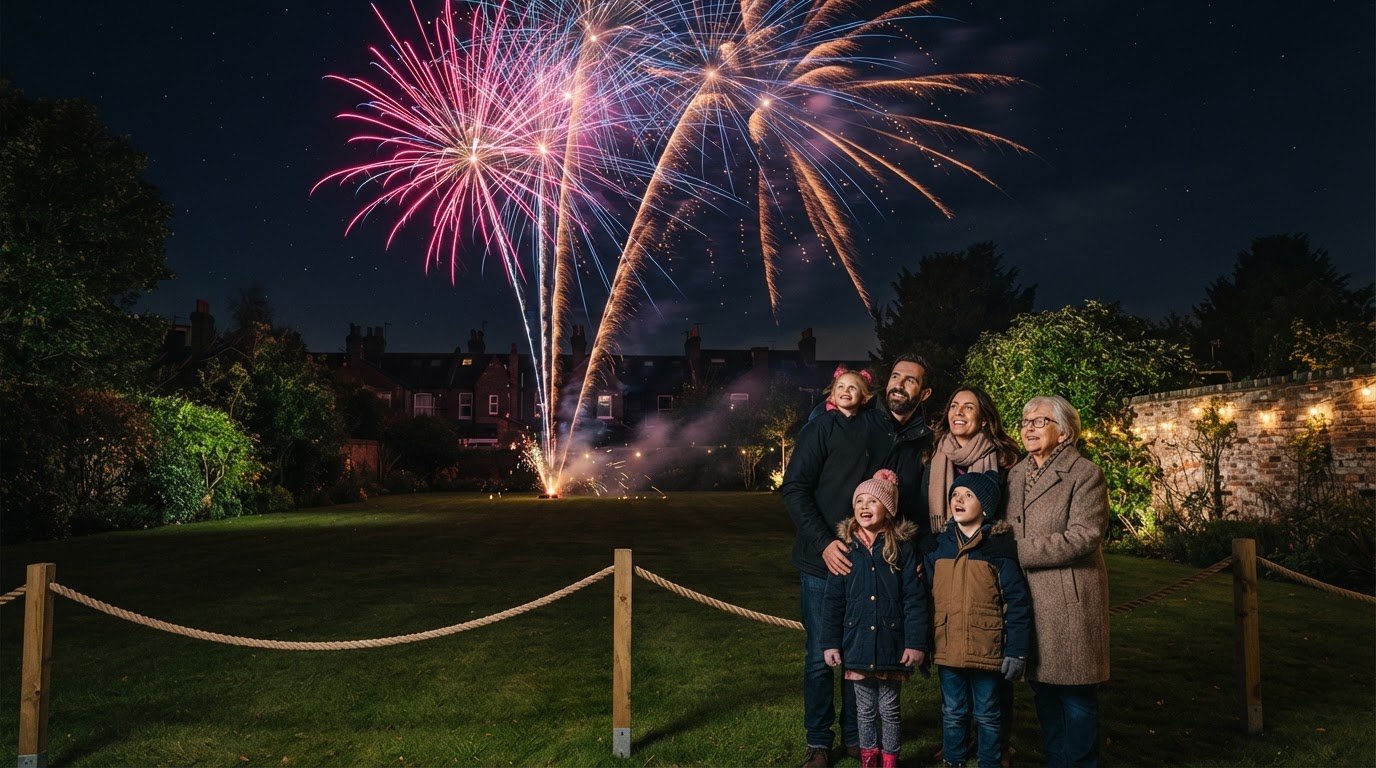
Firework safety is decided by the space around each device, not just the size of the garden. This firework safety distance guide starts with the key figures: spectators should stand at least 8 metres from Category F2 fireworks and 25 metres from Category F3 fireworks, or further if the instructions say so. These distances are minimums, not targets to reduce when space is tight.
It’s natural to ask whether fireworks are dangerous. They can cause harm if they’re set up or watched too closely, but careful planning helps keep the audience safe while creating a vivid display. Safety distances vary by firework, so follow the instructions for each item when planning your setup.
This firework safety distance guide explains how far spectators should stand, how to assess a garden and how to position barrages, rockets, fountains, mines and Roman candles. It also covers what to do when your garden cannot accommodate a firework’s stated distance: choose a display that suits the space rather than trying to squeeze one in.
Key Takeaways
- Keep spectators at least 8 metres from Category F2 fireworks and 25 metres from Category F3 fireworks, or farther if the instructions require it.
- Measure the usable space between the firing point and the audience before choosing fireworks; don’t use a firework if its required distance won’t fit.
- Check each firework’s instructions for its specific safety distance and setup directions, especially for different device types.
- Plan where children and other spectators will stand so they remain outside the safety zone throughout the display.
- Explore barrage options from 1st Galaxy Fireworks when selecting fireworks to suit your display plans and available space.
1. Minimum spectator distances for Category F2 and F3 fireworks
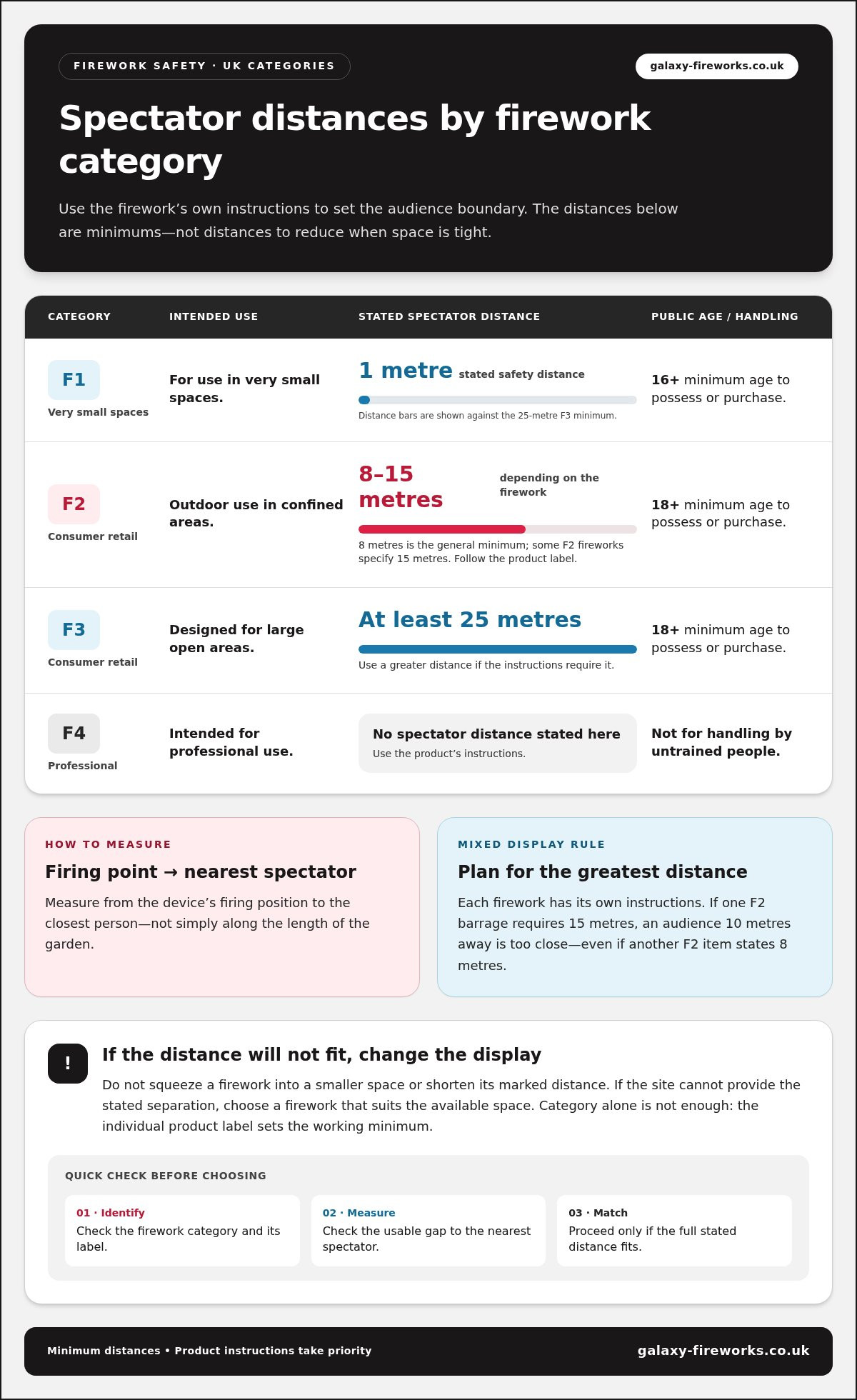
For UK spectators, the minimum distance is generally 8 metres for Category F2 fireworks and 25 metres for Category F3 fireworks. Follow the label if it gives a greater distance. Some F2 fireworks specify 15 metres, so the category alone cannot determine where your audience should stand. Measure from the firing position to the nearest spectator, not simply the length of the garden.
Consumer fireworks are divided into categories according to their intended use and hazard level. F1 fireworks are for very small spaces and have a stated safety distance of 1 metre. F2 fireworks are intended for outdoor use in confined areas, while F3 fireworks are designed for large open areas. F4 fireworks are intended for professional use and should not be handled by untrained people.
For a mixed display, plan around the item requiring the greatest separation. If a barrage’s label requires 15 metres, an audience 10 metres away is too close, even if another F2 item states 8 metres. If the site cannot provide 25 metres for F3, choose F2 only when the available space meets that particular firework’s stated distance. A firework safety distance guide is useful for planning, but each product’s instructions set the working minimum.
Age limits also affect which categories the public can handle: according to UK Government, a person must be aged 18 or over to possess or purchase CAT F2 or CAT F3 fireworks. F1 fireworks have a 16-year minimum age. For lighting, follow the product instructions, light one firework at a time at the end of the fuse, and keep your arm extended. Spectators should remain at their stated minimum distance; the label’s directions govern any protective equipment.
Most UK fireworks can be set off between 7am and 11pm. According to UK Government, the stated curfew exception is 1am on New Year’s Eve; on Bonfire Night, the exception is midnight. Keep the display within the permitted time, whether it follows a bonfire or marks Chinese New Year.
If a firework fails, never relight it. Wait at least 15 minutes after a misfire before approaching, and follow its instructions for safe handling. Keep fireworks in their original packaging, in a cool, dry place away from children and pets. During storage or transport, keep them in a closed box and take out only one at a time.
2. Keeping children and spectators at a safe distance
Give children a clear boundary between the audience and the firing area. Before setting up, choose a viewing point beyond each firework’s stated spectator distance, and keep the route to it clear. An adult should explain where everyone must stand before lighting begins, not move people once fireworks are underway.
Children and teenagers aged 10-17 are disproportionately affected by firework injuries. A firework can burn, while its sudden noise and bright effects may also alarm nearby children, pets and neighbours. Tell neighbours about the display in advance, particularly if children, older people, pets or other animals are nearby. Keep pets indoors and away from the garden during firing, where sound-dampening features can help settle them; home improvement specialists such as Galaxy Home Remodeling demonstrate how upgrading to quality replacement windows can noticeably reduce outdoor noise and improve household comfort.
Children under 8 should not be in the firework display area. Keep them with a responsible adult at the designated viewing point, not beside the person lighting fireworks. Older children should also remain spectators unless an adult is directly supervising a permitted activity. Make one adult responsible for watching the children, rather than assuming every member of the group is doing so.
Sparklers need separate care from garden fireworks. Only children aged 10 and over should use them, and only under close adult supervision. A sparkler can reach 1,500°C, around 20 times hotter than boiling water. The supervising adult should remain close, ensure the child holds it away from their body, and keep flammable clothing clear. Don’t let children run, wave sparklers near others, or carry them through a crowd.
Before handing out sparklers, explain where to stand, how to hold one and where to put it after use. Keep unused sparklers away from the activity, and give each child enough room to hold one without touching another person. When finished, put used sparklers straight into a bucket of cold water, as the UK Firework Code advises. Keep children away from the bucket and spent sparklers until an adult has handled them.
For Diwali or another family gathering, agree on the viewing area before guests arrive. Ask adults to keep children beside them, and keep the firing space clear throughout the display. If planning a family event, display planning for gatherings can help you think through the audience and layout together.
3. Safe distances for garden and display fireworks
Map the firing point, audience and surrounding space before choosing fireworks. For a mixed F2 and F3 display, position barrages and rockets at least 25 metres from spectators where that space is available. Measure from the nearest device to the closest person, and keep the audience beyond the distance printed on each firework.
Garden F2 fireworks can state minimum spectator distances from 8 to 15 metres. F3 fireworks generally require at least 25 metres, so a compact garden may not suit them. If your site cannot provide 25 metres, use F2 fireworks only when the garden meets their individual instructions. Don’t shorten a marked distance to fit a preferred display.
Plan the whole area, not just the gap between the firing point and spectators. Mark a clear firing space, the audience boundary and the direction fireworks will face. Keep people out of the firing area, and account for nearby boundaries, buildings, trees and other potential obstructions. For an F3 venue, allow a safety zone at least 25 metres wide all round. The fallout zone for the described venue layout can extend up to 50 metres.
Large outdoor displays need substantially more room than a typical garden. The stated guidance places spectators at least 50 metres from the firing area. It also describes a firing area at least 25 metres deep and 50 metres long, with a fallout area at least 100 metres deep and 150 metres long. These dimensions illustrate why a large display needs proper site planning, rather than simply moving garden spectators back a few steps.
For a home display, the usual UK restriction is that fireworks must not be set off between 11pm and 7am. According to UK Government, the stated exceptions are until midnight on Bonfire Night and 1am on New Year’s Eve. Keep the display within the permitted hours and follow the firework’s instructions.
Tell neighbours about the display in advance, particularly if children, older people, pets or other animals are nearby. A brief warning gives them time to prepare, bring pets indoors and keep their own gardens clear. Share the planned start and finish times, and make sure guests know where to watch from.
Before lighting, walk the site again. Confirm the audience boundary, clear the access route and check each firework’s position against its instructions. If the required distance does not fit, choose a different firework or a more suitable site. A well-planned display respects safe distances and the people living nearby.
4. Checking firework instructions and available garden space
Use the UK Firework Code for general safety steps, then read the label and instructions supplied with each firework. The label gives the product’s spectator distance and setup directions. Check these details before planning the garden layout, not while lighting is underway. If the instructions are missing or unreadable, don’t guess the distance or how the firework should be positioned.
Start by identifying the category and the stated distance for every item. F1 fireworks have a stated safety distance of 1 metre, while F2 fireworks may require 8 to 15 metres. F3 fireworks generally need at least 25 metres. These figures are minimums: if one firework requires 15 metres, an audience only 10 metres away is too close, even if another item’s instructions give a shorter distance.
Measure the clear space from the planned firing position to the nearest spectator. Include the audience area, the firing point and any garden boundaries when assessing whether the layout works. A garden with less than 8 metres of usable space is unsuitable for F2 fireworks. If it has less than 25 metres, don’t use F3 fireworks. Select fireworks whose stated distances fit the site, rather than moving the audience inside the safety zone.
Check the setup instructions for each type. Secure a rocket’s launch tube so it cannot fall over, and angle it slightly away from spectators. Secure cakes and barrages to a stake or post with strong tape or cable ties. Attach a Catherine wheel firmly to an upright post using its supplied nails. Keep the fuse accessible for lighting as directed, and place each item on stable ground.
Read the whole label, including instructions for lighting, positioning and spectator separation. Make sure the instructions are clear and written in English. Don’t move a firework intended for outdoor use indoors because the garden feels cramped. Wear clothing that allows safe handling and won’t catch on equipment while lighting. Never alter a firework or ignore a warning to make it fit.
Before Bonfire Night or Chinese New Year, walk the garden and compare the available space with each firework’s instructions. Mark the audience position, clear obstacles from the route and keep the firing area free of people. The UK Firework Code gives general advice; the individual firework’s instructions set its specific distance and setup. Follow both when preparing your display.
For general safety advice, consult the UK Firework Code. For each firework’s distance and setup requirements, follow its label and the instructions supplied with it.
5. Firing candles, fountains and mines
Roman candles, fountains and mines produce different effects, so don’t position them by appearance alone. The firework’s category and individual instructions determine the spectator distance and setup. A fountain produces effects from its position on the ground; a Roman candle fires shots upwards, while a mine launches an effect upwards from its base. Treat each as potentially dangerous and check its label before planning the firing area.
For a fountain, choose the position and surface specified in its instructions. Keep the audience beyond its stated safety distance, and don’t place it on a step, table or other raised spot unless directed. Check for obstructions above and around the fountain, and keep spectators clear of its effects. If the ground is uneven or you can’t set it up as instructed, choose another spot or firework.
A Roman candle needs careful positioning because its effects travel upwards from the device. Set it up exactly as directed, and aim or secure it only as its instructions specify. Point it away from spectators, and don’t place it where people could cross in front. Never hold or move a lit firework. Keep the audience beyond the device’s marked minimum distance.
Mines also send effects upwards, but their launch and effects differ from a fountain’s. Use the label to establish the required distance and placement, then check that the intended direction has clear space. Don’t assume a mine can share a firing position with a fountain or Roman candle. If you plan to use several consumer fireworks together, assess each separately and set the audience boundary at the greatest required spectator distance.
Secure a rocket’s launch tube so it cannot fall over, and angle it slightly away from spectators. This is a reminder that secure positioning matters throughout a display, but don’t apply rocket setup instructions to candles, fountains or mines. Follow each device’s own directions. Keep the fuse accessible as instructed, and don’t alter a firework to make it fit a smaller space.
Before lighting, carefully compare the marked distance with the available garden space, then place spectators beyond that boundary. If a larger effect means the required space will not fit, choose a different item rather than bringing the audience closer. Keep unused fireworks in a closed box, take out one at a time, and leave the firing area clear. Explore rockets, Roman candles, fountains and mines to consider which effects suit your display plans.
1St Galaxy Fireworks: Single Ignition Barrages
1st Galaxy Fireworks offers Single Ignition Barrages for readers planning a display and choosing fireworks that suit their available space. Compare each product’s instructions and spectator distance with your garden layout before deciding what to include. The label, not the product name, determines the safe setup and separation required.
If you’re shaping a display around different effects, 1st Galaxy Fireworks also offers Pro Barrages, Cake Barrages and Discounted Display Packs. Consider these options only after measuring the firing area and audience space, then follow every item’s individual instructions. If your site cannot accommodate a firework’s required distance, choose an option suited to the space instead.
Visit galaxy-fireworks.co.uk to explore barrage options for your display.
Plan a display that fits your space
Start with a clear plan for the event, not a shopping list. Decide what atmosphere you want, assess the available space, then choose effects that fit the site’s limits. A well-matched display can feel vivid and memorable without forcing an unsuitable layout.
Use this firework safety distance guide to compare options and plan your site. Keep the product instructions beside your plan, and mark the firing area and audience positions. This gives everyone helping organise the event a practical reference, from setup through to the final display.
If you’re arranging a wedding or corporate event, the right fireworks can help shape a striking moment for guests. For help exploring suitable options, contact 1st Galaxy Fireworks. Take your plans forward with care, and create a display everyone can enjoy.
Frequently Asked Questions
Are fireworks dangerous?
Yes. Fireworks can cause burns and other injuries, and sparks or effects can ignite nearby flammable materials. Risk increases when someone handles a device incorrectly, stands too close or approaches a firework that hasn’t gone off. Keep spectators away from the firing area and treat a failed firework as live. Pets and neighbours may also be startled by sudden noise, so plan for them before the display begins.
How strict are these distances?
Treat the stated distance as a minimum, not a flexible target. The closest spectator must remain beyond it, even if the rest of the audience stands further back. Don’t reduce the audience boundary to accommodate the garden layout or improve the view. If people might drift towards the firing area, assign an adult to keep the boundary clear throughout the display.
What about buildings, trees and so on?
Check the product instructions for positioning, and keep the firing area clear of obstructions. Trees, roofs and overhead lines can affect where a firework or its effects travel, while sheds and other structures may be vulnerable to heat or sparks. Don’t assume the spectator distance also provides enough clearance from nearby objects. If the site prevents the instructed setup, choose a different position or firework.
What should I do if someone is injured?
Stop the display and get medical help for a serious injury. For a minor burn, cool the area under cool running water for at least 20 minutes. Keep other spectators away from the firing area while help is arranged, and don’t approach a firework that may still be active. If the injury is severe or the person’s condition is worsening, seek emergency assistance immediately.
What are the recommended safety distances for different types of fireworks?
Use the category and the individual product label together: F1 fireworks have a stated distance of 1 metre, F2 fireworks may state 8 to 15 metres, and F3 fireworks generally require at least 25 metres. A specific label can require more than the usual category distance. For a mixed display, plan the audience position around the greatest distance required by any item.
How far should fireworks be from houses, sheds, cars and trees?
Use the product instructions to choose a firing position with clear space around the device and its effects. Don’t direct fireworks towards houses, sheds, parked cars or trees, and avoid positions where branches, eaves or other objects obstruct their intended direction. The audience distance does not automatically provide safe clearance from buildings or property, so assess those separately when planning the site.
