
Sky rocket safety, launches and quieter options
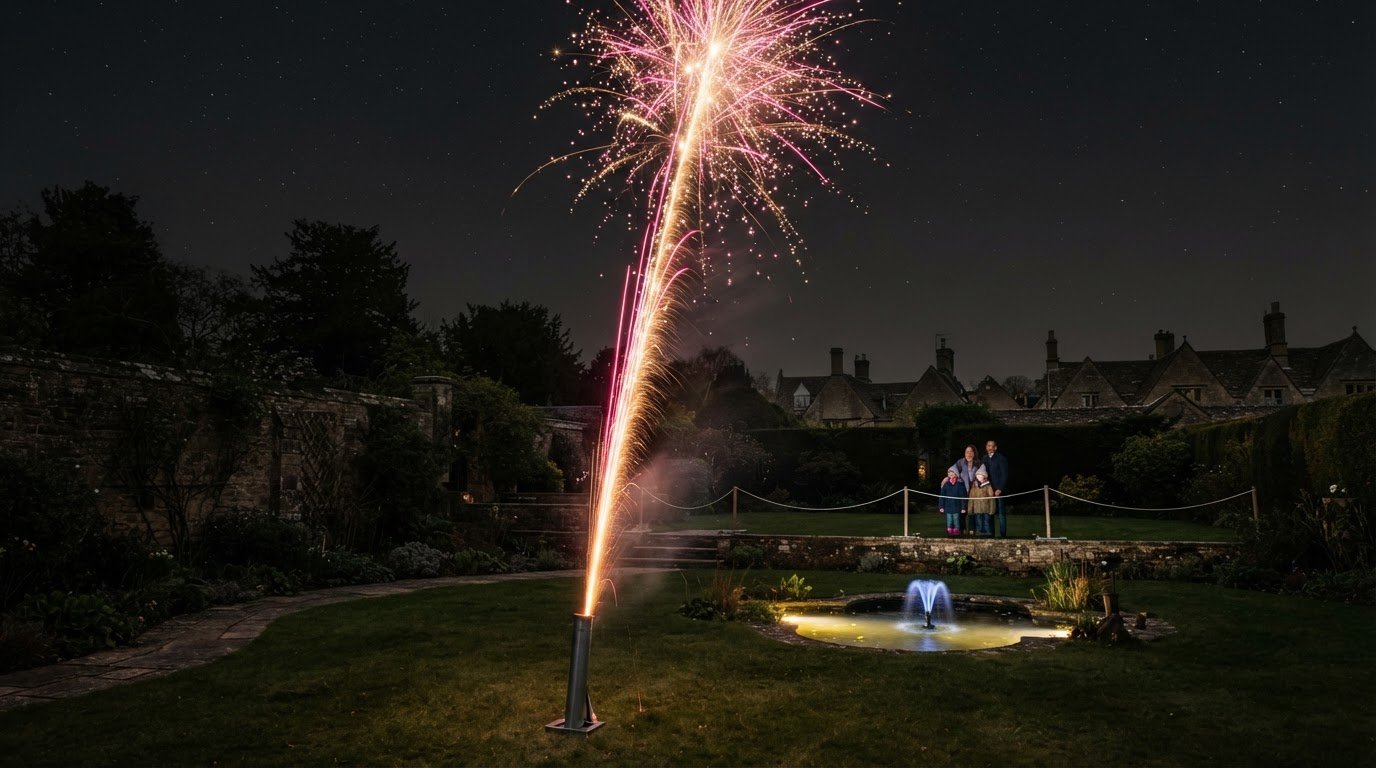
Safe rocket launches depend on the firework category and a clear launch area. In the UK, F2 sky rockets require an 8-metre safety distance, while F3 rockets require 25 metres; don’t push a rocket stick into the ground, as it can hit a stone and deflect sideways.
A sky rocket can add a striking lift and burst to a display, but it needs careful planning. Consider the launch space, the order of your fireworks and how rockets fit into the overall show, rather than treating each one as a standalone spectacle. This guide explains how rockets launch and burst, how to use them safely and how they compare with multi-packs. It also covers quieter options, so you can weigh visual impact against the sound and setting of your event. With these details in mind, you can choose fireworks that suit your celebration.
Key Takeaways
- Plan where rockets fit in the display so their bursts complement, rather than crowd, the other effects.
- Understand how a rocket’s motor creates lift and how its burst produces the display effect.
- Compare the sound and visual impact you want with the needs of your event when considering quieter options.
- Choose between individual rockets and a multi-pack based on the role they’ll play in your display.
- Recognise the main handling risks and build safe preparation into your launch plan.
Using rockets in a fireworks display
A firework rocket is an aerial firework that rises before producing an effect in the sky. Its height and burst can create a clear visual change between ground-based effects, such as fountains, and brighter aerial sequences. In a home display, plan its place in the running order rather than firing every rocket together. A typical home fireworks display might use 3-6 rockets spread across the show. This gives each launch a distinct moment and helps the display feel paced, rather than crowded.
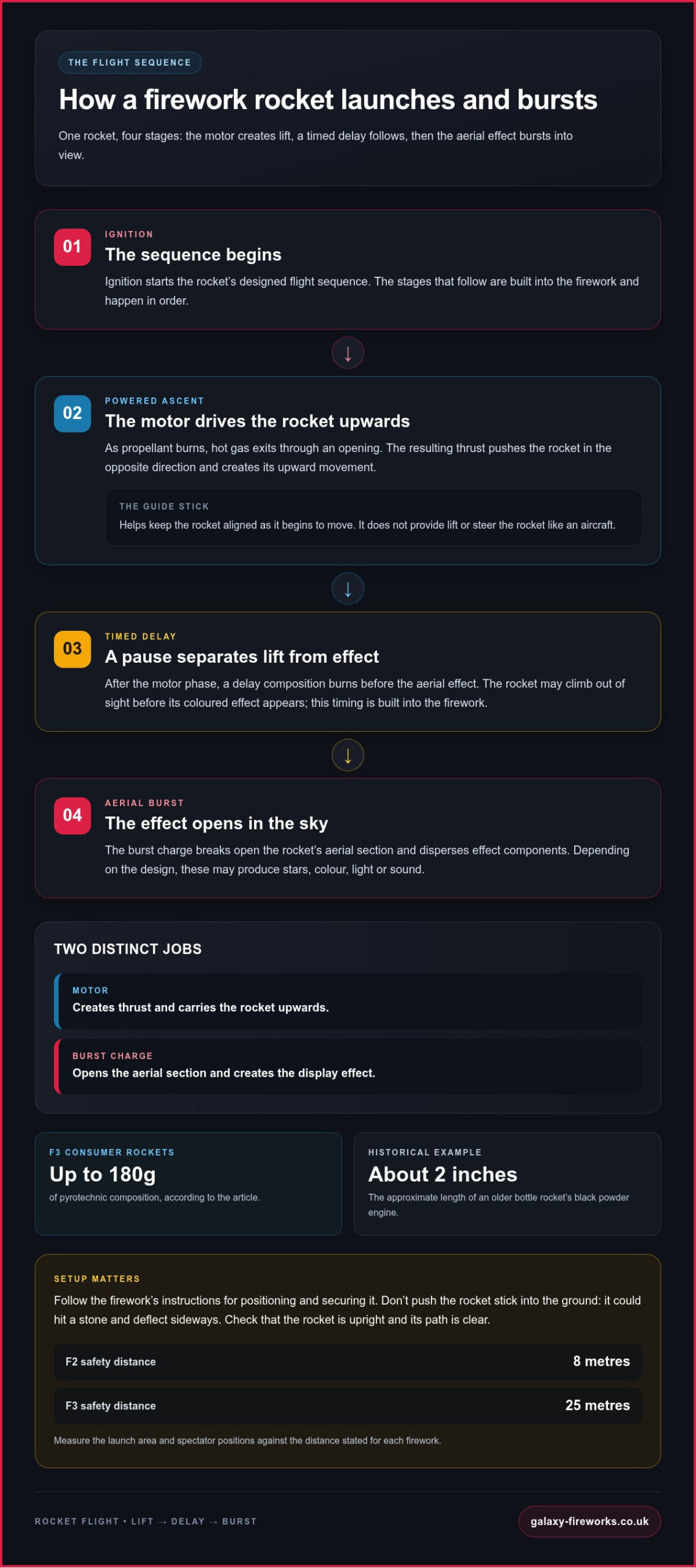
An F2 rocket is a category of firework with an 8-metre safety distance. An F3 rocket is a category with a 25-metre safety distance. These distances are essential planning details, not estimates of how far a rocket will travel. Before setting up, identify the category and safety distance stated for each firework. Then measure the launch area and spectator positions against that distance. If the space available cannot accommodate the stated distance, that rocket is not suitable for that launch area.
A safety distance is the separation required between the firework and spectators or other relevant surroundings. For F2, keep the 8-metre distance; for F3, keep 25 metres. Include the audience’s viewing position when planning, rather than measuring only from the point where the rocket will stand. Check the whole area the firework needs, and avoid arranging people where they could drift inside the marked boundary during the display. A simple site sketch can help: mark the launch position, the audience, and each category’s required distance before carrying fireworks outside.
A rocket stick is the attached guide that helps a rocket rise after ignition. Don’t push it into the ground: it could strike a stone and deflect the rocket sideways. Follow the firework’s instructions for positioning and securing it. Check that the rocket is upright and its path is clear, with no obstruction in its intended direction of travel. Keep the launch point separate from the audience, and don’t change the setup once people have gathered. These steps help reduce the risk of a poorly positioned rocket travelling towards spectators.
A display sequence is the planned order in which fireworks are launched. Place rockets between other effects where their upward movement and aerial burst can add contrast. For example, a rocket can follow a lower-level effect, giving the audience a change in height and pace. Leave enough time to prepare each launch carefully; speed should never replace a clear setup. If the display includes both F2 and F3 fireworks, organise them by category and safety distance before starting. That makes it easier to maintain the correct separation throughout the show.
Launch planning is the practical process of matching each firework to the site and sequence. Start by measuring the available area, then compare it with the 8-metre F2 or 25-metre F3 requirement. Decide how many rockets fit the display’s rhythm, using 3-6 as a typical home-display example, not a target. Keep the instructions with each firework in view during setup. A well-spaced sequence makes every launch easier to follow and gives each burst room to stand out.
How firework rockets launch and burst
A firework rocket is an aerial firework that uses an onboard motor to rise before creating a visual effect. Its flight has distinct stages: ignition, powered ascent, a timed delay and the burst. Understanding these stages explains why the effect appears after the rocket leaves the ground. A burst high above the launch point, for example, follows the motor’s powered climb rather than a separate launch mechanism.
The motor is the section that produces thrust and drives the rocket upwards. As its propellant burns, hot gas exits through an opening, pushing the rocket in the opposite direction. This action is called thrust. Older bottle rockets typically had a black powder engine about 2 inches long. That historical example helps illustrate how a compact motor can propel a small rocket, though modern firework designs vary in construction and effect.
The guide stick is the long attached rod that helps keep a rocket aligned as it begins to move. It supports a stable departure as part of the rocket’s design, but does not provide the upward force. That comes from the motor. Once the rocket is moving, the stick does not steer it like an aircraft. Proper setup before ignition is essential: the rocket’s flight depends on its design and a clear path.
A delay composition is material that burns after the motor phase and before the aerial effect. It creates a pause between the visible ascent and the burst. The rocket may climb out of sight before its coloured effect appears. This timing is built into the firework, not controlled by someone after launch. The pause creates the familiar sequence of a rising point of light followed by a sudden bloom.
The burst charge is the part that breaks open the rocket’s aerial section and disperses its effect components. These components may produce stars, colour, light or sound, depending on the firework’s design. A rocket’s burst is therefore distinct from its motor: one creates the ascent, while the other creates the display in the sky. UK consumer F3 firework rockets can carry up to 180g of pyrotechnic composition. The amount and arrangement of composition influence the designed effect, but don’t identify the full performance on their own.
F3 is a fireworks category used to classify products, including some consumer rockets. A rocket in this category may combine a motor, delay and aerial effect within one item. Those stages happen in sequence, not as separate fireworks. The same basic idea applies to a sky rocket: propulsion carries it upwards, then a timed effect produces the burst. The precise colour, shape and sound depend on the rocket’s individual construction.
Reading the product instructions helps match the rocket’s intended use with your display plan. Look for its category and stated effect, then consider where the rising movement and burst will sit among other fireworks. If you’re planning a larger sequence, rocket effects for a display can help you explore the visual role they might play.
Noise levels and quieter rocket options
A firework’s noise level describes the loudness and character of its sound during launch and burst. A rocket may make noise as it rises, then produce another report when its aerial effect opens. These are separate parts of the experience. If noise matters at your event, assess both the launch and the burst, not just the effect description or its appearance in a photograph.
A report is the sharp bang created by a firework’s burst. A display built around reports can feel dramatic, but repeated bangs may not suit every setting. At a family gathering with young children or noise-sensitive guests, for example, fewer report-led effects may be a better fit. Consider when the loudest sounds will occur and whether guests can watch from a comfortable position.
A quieter option is a firework that emphasises visual effects over loud reports. The term doesn’t guarantee silence. Fireworks still make sound during ignition and operation, and the experience depends on the product’s design. Read the description for details about sound and effects, then compare them across the products you’re considering.
Use these steps to assess the sound profile before choosing:
- Separate launch and burst. Look for details describing both stages, rather than assuming the burst is the only sound.
- Compare effects. Set report-led products beside options described through colour, light or visual movement.
- Plan the sequence. Avoid placing several loud effects together if you want a gentler rhythm.
- Consider the audience. Choose a viewing position and programme that suit the people attending.
A sound profile is the pattern of noise across a firework’s different stages. One product might have a noticeable launch sound and a loud final report, while another description focuses on colour and light. Don’t treat “quieter” as a precise measurement unless the product provides one. Instead, compare the stated effects and decide which sound characteristics matter most for your occasion.
Fountains are ground-based fireworks that create effects close to the launch point. They offer a different visual style from a rocket’s ascent and aerial burst. Compare product descriptions carefully, since sound depends on the individual firework, not just its broad category. In a mixed display, combining types can vary the visual rhythm without making every moment revolve around a high aerial report.
For a wedding or community celebration, consider sound from the start of your display planning. Think about guests who may be sensitive to sudden bangs, then choose effects with their comfort in mind. A quieter-focused programme can still feature colour, sparkle and movement, with less emphasis on sound. Follow the product instructions, and never alter a firework to change its noise.
Single rockets versus multi-packs
A single rocket is one separately packaged firework, while a multi-pack groups several together. The right choice depends on your display plan, launch space and desired variety. One rocket can suit a specific moment, such as an aerial burst between other effects. A pack gives you several launches to arrange throughout the show. Neither format automatically makes a better display: the key difference is how much choice and sequencing you need.
A six-rocket set is an example of a smaller collection, while a multi-pack example contains 80 rockets. Those quantities show how widely pack sizes can differ. Don’t assume every pack has the same mix or effect: read its description and identify what each item contributes. If you want one particular burst, a single rocket may be easier to match to that role. If you want repeated launches, a larger pack may offer more items to organise.
Display pacing is the spacing and order of effects throughout a show. With individual rockets, you can choose specific effects and place them at particular moments. A pack can simplify selection if its contents suit your plan, but it still needs a deliberate sequence. You might reserve some rockets for later in the display rather than launching every item consecutively. Treat the pack as a collection of separate fireworks, not one continuous effect.
Use this comparison before choosing:
- Choose single rockets when you need a specific effect or only a small number of launches.
- Choose a multi-pack when you want several rockets available for a sequence.
- Compare contents by reading each product description, including category and effects.
- Plan the storage and setup for the full quantity, following each firework’s instructions.
A product category is the classification that helps identify a firework’s intended use and safety distance. F2 and F3 rockets have different stated distances, so a pack’s quantity alone doesn’t determine whether it suits your site. Check the category and instructions for every rocket, including items grouped inside one pack. If the required space differs between items, plan around the largest distance needed for the products you intend to use.
Value means how well a purchase serves your particular display, not simply how many rockets are in the box. A larger pack may include effects that don’t suit your planned sequence or audience. A single rocket may work for a focused display but offer less variety. Compare the listed effects, quantities and categories, then choose the format that matches your space and running order. Don’t use every item just because it is included.
For a home display, begin with the sequence you want, then work out whether individual rockets or a pack best supports it. A typical home show might use 3-6 rockets spread across the display, but this is an example, not a required quantity. Match each selection to the site, instructions and intended effect. This approach keeps the choice centred on the display you can safely organise, rather than the biggest pack available.
What risks and injuries are associated with sky rocket fireworks?
A firework injury is physical harm caused by a firework or its effects. With a rocket, risk can arise if it travels away from its intended path or people approach while it is operating. The launch and burst are separate stages, so hazards can occur at different points. Planning the launch area, audience position and handling steps helps reduce avoidable exposure during the display.
A deflection is a change from the rocket’s intended direction of travel. If pushed into the ground, a rocket stick can hit a stone and cause the rocket to deflect sideways. Keep the stick out of the ground and follow the product’s setup instructions. Before setup, check the launch area for stones and other obstructions. Keep spectators in a separate viewing area, and never hold or try to steer a rocket by hand.
A burn is harm caused by contact with heat or flame. A rocket contains burning material during operation, so touching it after ignition or approaching it too soon can expose someone to heat. Follow the lighting instructions for that specific firework, and keep people away from its operating area. Don’t handle a firework that has failed to launch. Follow its misfire instructions and never try to relight it.
A misfire is a firework that fails to operate as intended after ignition. It may not be safe to approach just because it appears inactive. Keep spectators away, don’t touch or move it, and follow the product’s directions. During a display, make sure the person responsible for launching knows which item has misfired. This helps prevent someone else from approaching without knowing what happened.
Audience encroachment is when spectators move too close to the launch area. It can happen as people change viewing positions or try to get a better view. Mark the viewing boundary before the display and keep the launch route clear. For an F2 rocket, the stated safety distance is 8 metres; for F3, it is 25 metres. Check the category on each firework and organise the audience accordingly.
Use this practical check before lighting:
- Read the instructions. Follow the setup and lighting directions for that specific rocket.
- Inspect the launch area. Look for stones or other objects that could interfere with its path.
- Position spectators. Keep everyone at the product’s stated safety distance.
- Leave misfires alone. Keep people clear and follow the product’s directions.
For a wedding or organised event, include the launch area and audience positions in the site plan. A clear layout helps guests understand where to watch without approaching the fireworks. Plan your fireworks display with safety and viewing positions in mind.
1St Galaxy Fireworks: Single Ignition Barrages
1st Galaxy Fireworks offers Single Ignition Barrages for displays where you want several effects launched as one coordinated sequence. If you’re weighing rockets against other formats, barrages provide an alternative way to build a show without planning each effect as a separate rocket launch. Pro Barrages and Cake Barrages offer further categories to consider, while Discounted Display Packs can suit those comparing grouped options.
Choose according to your available space, the visual rhythm you want and the product instructions, including the stated safety distance. For a wedding or corporate event, these options can help shape a display around its setting and audience. Explore the barrage and pack categories, or visit galaxy-fireworks.co.uk to see the available options.
Shape the display around your occasion
Your next decision is the atmosphere you want guests to remember. A sky rocket can create a striking aerial moment, while a sequence of barrage effects offers another way to build visual impact. Match the format to your venue, audience and preferred pace, then use that choice to guide the rest of your display planning.
1st Galaxy Fireworks offers Single Ignition Barrages, Pro Barrages and Cake Barrages, giving you several formats to consider alongside rockets. Think about how each option could contribute to the experience, rather than choosing solely by appearance. The right plan brings the effects together with purpose and keeps your event’s character at the centre.
Ready to explore options for your display? Contact 1st Galaxy Fireworks and take the next step towards a celebration with a memorable finish.
Frequently Asked Questions
How do you launch firework rockets safely?
Prepare the launch site and read the individual rocket’s instructions before setting anything up. Check overhead and nearby spaces for trees, buildings, cables or other obstructions, and keep the audience in a clearly separate viewing area. Use only the launch arrangement specified for that firework. Don’t improvise a holder or alter the rocket. Before lighting a sky rocket, make sure everyone knows where to stand and can watch without approaching the launch point.
What Makes a Good Rocket?
A good rocket suits your display space, audience and intended visual effect. Start with its category and instructions, then consider whether its colours, burst and sound suit the occasion. A bright aerial effect may work well in a finale, while a quieter-focused event may call for different effects. Clear product information also helps you plan how the rocket fits alongside other fireworks. Choose a sky rocket for its suitability, not its appearance alone.
What is the difference between single rockets and rocket packs?
A single rocket is one firework chosen on its own; a rocket pack contains several. Choose an individual item when you want to match a particular effect to your display. A pack may suit a plan that calls for a range of launches, but its contents still need to fit your site and running order. Compare the effects and categories in a pack before deciding whether every rocket suits your event.
What is a sky rocket firework?
A firework rocket is designed to rise into the air before producing an effect. Its motor provides lift, and a timed section triggers the aerial burst after ascent. The firework’s design determines the visible result, including its colour, pattern and sound. In a display, that upward movement creates a different visual moment from ground-based effects such as fountains.
How much do sky rocket fireworks cost in the UK?
At 1st Galaxy Fireworks, sky rocket prices in the UK vary depending on whether you are buying single items or diverse rocket packs. Individual rockets can range from a few pounds for smaller versions up to higher prices for large, professional-grade aerial effects. Rocket packs offer great value for money, generally costing anywhere from £15 to over £100 depending on the quantity, size, and overall performance of the fireworks included.
