
Long Lasting Firework Barrages: Effects, Contents and Duration
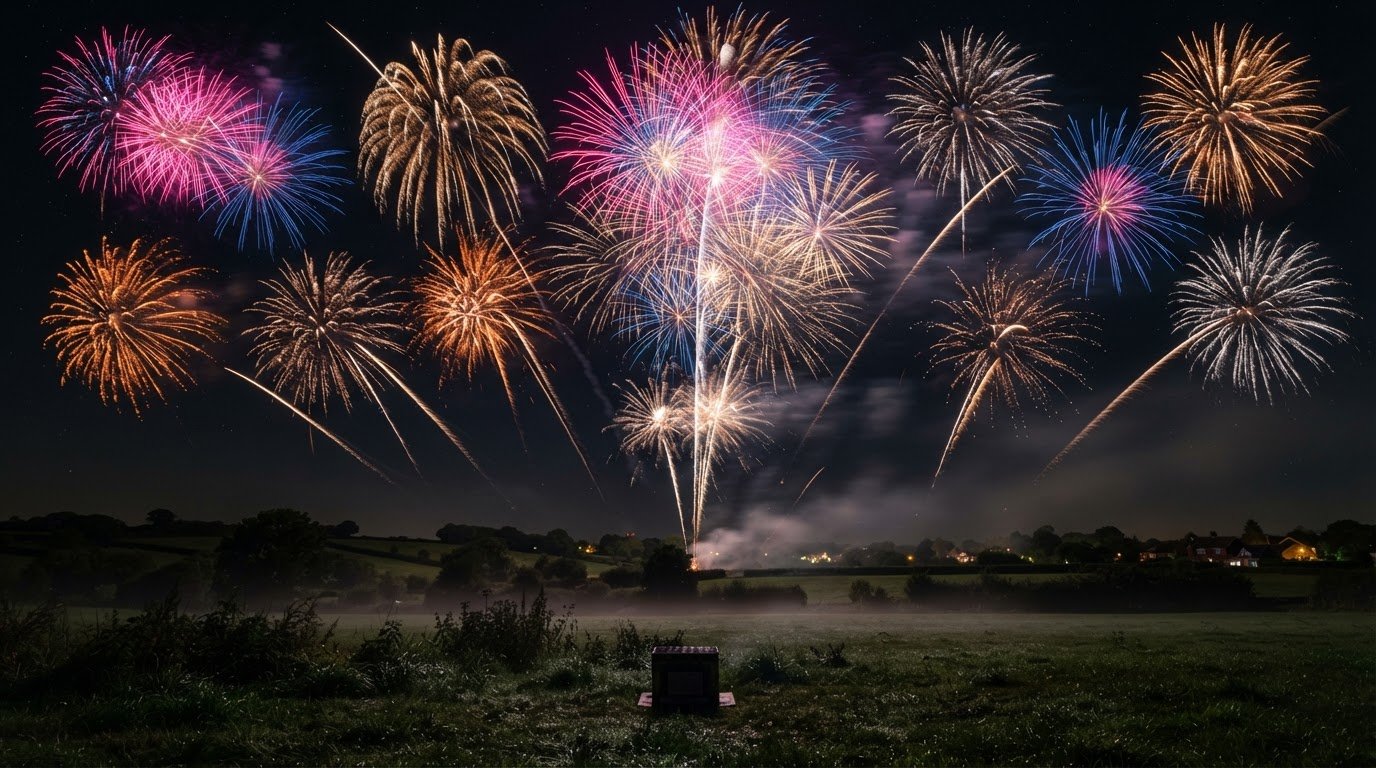
More shots don’t automatically mean a longer display. Long lasting firework barrages can run from a brief sequence to several minutes, depending on how quickly the shots fire and whether multiple cakes are linked into a compound. Many firework cakes and barrages run for around 20 to 60 seconds, while some barrages last several minutes.
It’s easy to focus on shot count when choosing long lasting firework barrages, but firing pace, effect variety and running time all shape the spectacle. This guide explains what barrage packs can contain, how shot count relates to performance and what influences a cake or barrage’s duration. You’ll also learn how to plan the firing order and choose fireworks that suit your event, so you can create a bright, memorable finish without relying on a headline number alone.
Key Takeaways
- Use shot count as only one clue: firing pace and whether a firework combines several cake sections also affect how long the display lasts.
- Compare the stated duration and sequence of effects to plan a display with the pace and finish you want.
- For a longer continuous sequence, understand how compound fireworks use multiple cake sections joined by internal fusing.
- Category F3 fireworks are intended for outdoor use in large open areas and present a medium hazard, according to UK Government, legislation.gov.uk.
- Read the firework’s label and follow its safety distance and firing instructions when planning where it will be used.
Barrage pack contents and suggested firing order
A barrage pack can combine fireworks with different shot counts, effects and firing styles, so the total count doesn’t tell the whole story. Read each item’s label and stated running time to plan a sequence that builds towards a strong finish.
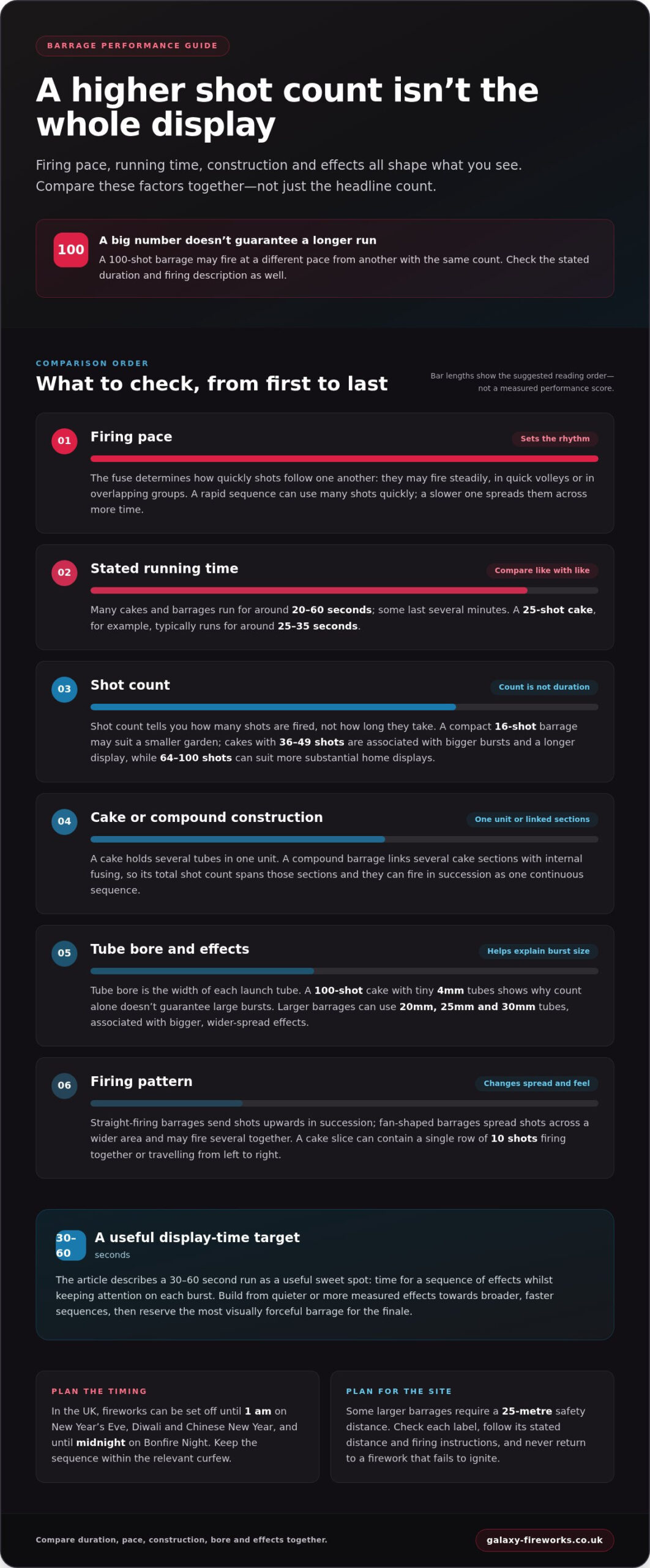
Compare the contents item by item. A pack might include single-ignition barrages, while other display packs may combine different firework types, such as rockets. A 100-shot barrage is one example of a high shot count, but it may fire at a different pace from another product with the same number of shots. The pack’s total therefore doesn’t indicate how many shots one firework fires, or how long the full sequence will last.
For a compound barrage, internal fusing links several cake sections into one unit. Keep it in its outer carton during setup, as removing it can damage the linking fuse or supporting board. Carefully cut away the opening flaps, making sure no cardboard is left high enough to obstruct fan-shaped sections. Keep the supplied plastic bag in place until firing time, and position the compound on level ground.
Timing and display impact
Balancing firing time and impact means choosing a duration that suits the occasion without losing the display’s sense of pace. A 30 to 60 second run is a useful sweet spot: enough time for a sequence of effects, while keeping the audience’s attention on each burst. Plan the firing order around the labels, leaving the most visually forceful barrage for the finale.
Factor in the permitted firing window, too. In the UK, fireworks can be set off until 1 am on New Year’s Eve, Diwali and Chinese New Year, and until midnight on Bonfire Night. Finish within the relevant curfew rather than allowing a long-running sequence to overrun.
Patterns and fuse speeds
Firing patterns describe how shots are arranged in the sky, whilst fuse speed affects how quickly they follow one another. A straight-firing barrage sends shots upwards in succession; a fan-shaped barrage spreads shots across a wider area, sometimes firing several together. A cake slice can contain a single row of 10 shots that fire together or travel from left to right.
Firing patterns change the rhythm as well as the spread of effects. A straight sequence can create a steady build, while a fan can deliver a broader impact. Read the firing description before deciding where each firework belongs in the sequence, and make sure its position suits its shape.
Build a display from quieter or more measured effects towards broader, faster sequences, then end with the strongest barrage suited to the site. This approach gives each firing a clear role rather than letting every item compete for attention. Category F3 fireworks are intended for outdoor use in large open areas and present a medium hazard, according to UK Government, legislation.gov.uk. The manufacturer’s stated safety distance should guide spectator placement.
Choose the sequence around the venue, not shot count alone. A smaller garden may not be suitable for larger fireworks: some larger barrages require a 25-metre safety distance. Check each label, keep spectators at the specified distance, and never return to a firework that fails to ignite.
Does a higher shot count mean a better firework?
A higher shot count can mean more bursts, but it doesn’t automatically mean a longer or more impressive display. Firing pace, tube bore, effects and whether several cakes are combined all affect performance.
Shot counts and firing duration
Shot count measures how many shots a firework fires; duration tells you how long they take to fire. A compound combines several cake sections with internal fusing, so its total count includes shots across those sections rather than from one straight sequence. The fuse sets the pace: shots may fire steadily, in quick volleys or in overlapping groups. Compare the stated duration as well as the total count when planning your display.
Cake construction and shot counts
A cake holds multiple shot tubes in a single unit, and its layout shapes how those shots appear. A compact 16-shot barrage can suit a smaller garden, whilst cakes with 36-49 shots are associated with bigger bursts and a longer display. Cakes with 64-100 shots can suit more substantial home displays. These ranges describe different options, not a rule that every higher count performs better.
Barrage duration and shot numbers
Shot count and duration only make sense together: a rapid firing pattern can use many shots quickly, while a slower sequence spreads them across more time. For example, a 25-shot cake typically runs for around 25 to 35 seconds. A compound can increase the total number of shots by linking multiple cake sections, but the firing pace still determines the elapsed display time. Use the product’s stated duration to compare like with like.
Shot counts and tube bore size
Tube bore is the width of an individual launch tube, so it tells you something different from the number of shots. A 100-shot cake made with tiny 4mm tubes illustrates why a high count alone doesn’t guarantee large bursts. Larger barrage fireworks can use 20mm, 25mm and 30mm tubes, which are associated with bigger, wider-spread effects. Compare bore, effects and shot count together for a clearer picture.
Weight is another useful specification, but it doesn’t replace the stated duration or effect description. Two cakes with the same shot count can differ in tube size, firing pattern and visual variety. A compound may provide a longer continuous sequence as its sections fire in succession, while a fast cake can deliver a sharper, shorter impact. Check each product’s stated duration and pattern before deciding which suits your venue and display plan.
For a practical comparison, explore barrage options by shot count and duration.
Firework cake and barrage definitions
A firework cake is a single unit containing several tubes, which launch shots in a planned sequence after ignition. “Barrage” is commonly used for a firework that fires a succession of shots, and product descriptions may use the terms together. A cake might contain 25 shots and run for around 25 to 35 seconds, giving a compact sequence without lighting each shot separately.
For a garden display, check the product’s shot count, duration, effects and required safety distance together. Smaller garden cakes typically contain 9 to 36 shots, while the wider range includes cakes with more than 600 individual bursts. Those figures describe different scales of firework, not a promise that every higher count produces a longer or more impressive display. The firing pace and pattern shape what the audience sees.
A compound firework brings multiple cake sections together in one unit, connected by internal fusing. Instead of lighting each cake separately, the linked sections fire in one continuous sequence. This can suit an occasion where you want a longer run without manually starting each section. The total shot count combines the shots across all sections, so compare the stated duration as well as the count.
Descriptions can vary, so focus on what each term means for the firing experience. “Single ignition” means one lighting point starts the sequence, while “compound” describes linked sections that fire in succession. “Cake” refers to a unit of grouped tubes. A fan-shaped cake spreads shots across an angled pattern; a straight-firing cake sends them upwards in a narrower line. These details help you picture the display and choose a suitable position.
Price varies with construction and performance. Tube bore, shot count, effects, category and whether the firework is a single cake or compound all affect its specification and value. A cake with many small tubes differs from one with fewer, larger tubes, even if both produce a striking sequence. Compare the listed features with your occasion and site rather than treating the highest shot count as the best value.
To make a practical comparison, first match the required safety distance to your available space. Then compare duration, shot count and firing pattern, checking whether the item is a single cake or a linked compound. For example, a 25-shot cake lasting 25 to 35 seconds offers a different experience from a compound that joins several sections. That distinction matters when planning the display’s pace and final impact.
Firework effects
Effects depend on how a firework fires, the shape of its tubes and the height of its bursts. Check these details to match the display to your space and occasion.
Fan cakes and salvo effects
A fan cake sends shots outwards in an angled pattern, while a salvo releases several shots in a rapid group. These arrangements create a broader or more sudden impact than a straight sequence, which sends shots upwards in a narrower line. Read the product description to picture the pattern before choosing a position.
For a wedding or celebration, a fan-shaped section can give the display width, while a salvo can create a concentrated burst of activity. Some fireworks fire several shots at once, so effects may overlap instead of appearing as separate bursts. Consider how the pattern will look from the audience’s viewing point, and follow the safety distance and firing instructions on the label.
Effects and firing height
Firing height affects where an effect appears in the sky and how much room it occupies above the launch point. A barrage pack described as firing to a height of 25 metres gives a useful indication of its vertical reach. Height alone doesn’t tell you the full visual impact, since the pattern, pace and spread also shape the display.
Before lighting, compare the stated height with the site’s surroundings and the audience’s position. Keep the manufacturer’s recommended distance, using the product’s stated safety distance to guide placement. This is particularly important for fan-shaped fireworks, whose effects spread sideways as well as upwards.
A dump cake is designed to fire its shots in a very fast sequence. One example fires 25 shots in a second or so, creating an immediate, concentrated impact rather than a measured build. That pace can make a striking moment within a display, but it won’t provide the same drawn-out progression as a slower-firing cake.
Read the effect description alongside the firing pattern. A single-ignition firework starts from one lighting point, but its shots may still fire rapidly, steadily or in grouped salvos. This distinction helps you decide whether it suits a dramatic opening, a transition between sections or a finale. For a longer celebration, you can pair a fast-firing cake with fireworks that fire at a more measured pace.
Effects can also differ in scale. Smaller garden cakes typically contain 9 to 36 shots, while larger compounds can create a broader, more substantial display. The required viewing distance is part of that choice: some larger barrages need a 25-metre safety distance. If the site cannot provide the distance stated on the label, choose a firework suited to the available space instead.
Build a balanced display with varied effects rather than relying on one throughout. A fan-shaped sequence, a quick salvo and a slower succession each bring a distinct visual rhythm. Check the label for firing pattern, height and safety distance before lighting, then arrange the sections so each effect has room to register.
Firework cake and barrage durations
A firework’s duration is its firing time, not its shot count or the length of an entire planned display. UK product listings group durations from 1 to 20 seconds, 21 to 40 seconds, 41 to 60 seconds, 60 to 120 seconds and over 120 seconds. These bands help compare cakes and barrages by how long their effects unfold.
Most cakes and barrages run for around 20 to 40 seconds, though some barrages last several minutes. A longer duration can come from slower firing or linked sections, rather than simply adding more shots. For instance, a barrage firing 100 shots rapidly could finish sooner than a lower-count firework with a slower sequence. Check the stated duration alongside counts to judge the pace you’re buying.
Duration matters when shaping a display’s rhythm. A short cake can make a concentrated moment, while a slower firework gives its effects more time to develop. The often-useful 30 to 60 second range balances firing time with impact, but the right fit depends on the overall sequence and site. If combining separate items, add their stated running times to estimate the programme, while allowing for the pauses needed to light each one safely.
Tube bore offers another clue, but it doesn’t determine duration on its own. Larger barrage fireworks can use 20 mm, 25 mm and 30 mm tubes, while consumer shot tubes can have a bore of up to 30 mm. Bore, firing rate, shot arrangement and the number of linked cake sections all affect the experience. Compare these details with the effect description rather than assuming a wider tube means a longer run.
Check the safety distance before buying, because the site must accommodate the firework as well as its running time. Larger barrages may require a 25-metre safety distance, while some garden cakes have an 8-metre distance. These are product-specific examples, so follow the distance printed on the firework’s label. A display lasting several minutes still needs suitable space throughout its firing.
Plan around the event’s permitted firing window, too. On Bonfire Night, fireworks can be set off until midnight in the UK. A long sequence needs to finish within that window, including the time needed to light individual fireworks. Add up each item’s stated duration, then arrange the firing order to suit the available time and site.
For your event, browse barrage options by duration and compare each firework’s running time with its safety distance and firing pattern.
1St Galaxy Fireworks: Single Ignition Barrages
1st Galaxy Fireworks offers Single Ignition Barrages for a straightforward sequence, alongside Pro Barrages and Cake Barrages for different display plans. If you’re comparing running times and effects, these categories help narrow your choice to the kind of firing experience you want. Discounted Display Packs bring together fireworks for a broader display, giving you another option when planning a celebration.
Choose fireworks by matching the product description to your available space, preferred pace and intended finish. Check each item’s stated duration, firing pattern and safety distance, then plan the sequence around those details. This helps you select suitable fireworks without treating shot count as the only measure of performance.
For help choosing between barrage options, contact 1st Galaxy Fireworks or visit galaxy-fireworks.co.uk.
Shape your next display around the occasion
Start by deciding what you want the display to create: a measured build, a burst of colour or a striking final moment. Consider how you want the experience to feel for your guests, then choose products that work together to bring that vision to life. Long lasting firework barrages can contribute to a fuller sequence, but the overall impression depends on how each element complements the others.
1st Galaxy Fireworks offers Single Ignition Barrages, Pro Barrages and Cake Barrages, giving you options to consider as you shape your display. If you’re planning a personal celebration or a larger event, focus on the atmosphere you want and the practical needs of your site.
Take the next step and explore the options that fit your plans. Contact 1st Galaxy Fireworks today to discuss your fireworks selection. With a considered plan, you can look forward to a memorable occasion and a finale that feels just right.
Frequently Asked Questions
Need help with the Barrage Fireworks?
1st Galaxy Fireworks offers Single Ignition Barrages, Pro Barrages, Cake Barrages and Discounted Display Packs. To narrow down the options, start with your event setting and the kind of sequence you want, such as a steady progression or a strong finale. Then compare each firework’s stated duration, effects and safety distance. These details help you choose a barrage that fits both your display plan and available space.
Are barrages good value?
Barrages can offer good value when their effects and running time suit the role you need them to play. One barrage, for example, may provide a complete feature moment, while several smaller fireworks may add more variety across a programme. Compare the stated duration, shot count and effects with the listed price, then decide whether you want one continuous sequence or separate moments with pauses.
Are barrages suitable for beginners?
Some consumer barrages are straightforward to use, but suitability depends on the specific firework and its instructions. If you’re new to fireworks, read the label before setup, check the required safety distance and place the barrage on a firm, level surface. A single-ignition design can simplify the sequence, but lighting still requires care and immediate retreat to the stated distance. Never return to a firework that fails to ignite.
Are compound barrages worth buying?
A compound barrage can suit you if you want several cake sections to fire as one linked sequence. Its internal fusing means you don’t need to light each section separately, which can make the display easier to organise. It’s less suitable if your site can’t provide the stated safety distance or you want to control the pace by lighting individual fireworks. Compare the compound’s duration and effects with your planned programme.
How long do UK firework barrages last, and how many shots do they contain?
UK barrage durations range from brief sequences to several minutes, and shot counts vary just as widely. Product listings include durations from 1 to 20 seconds through to over 120 seconds. Cakes can range from 9 to over 600 individual bursts. Treat those as separate specifications: the firing pace affects how long the shots take, so use the stated duration rather than estimating from shot count alone.
Which UK fireworks have the best duration for their price?
No single type offers the best duration for every display. Compare the price with the stated running time, effects, shot pattern and safety distance, then decide whether the firework fills a useful role. A longer sequence may suit a centrepiece, while a shorter, faster display can add impact between other items. Comparing similar products by duration and effects is more useful than comparing shot count alone.
How much do long-lasting firework barrages cost in the UK?
Costs vary by firework, so compare individual listings rather than relying on one typical figure. Product type, tube size, shot count, effects and whether sections are linked all affect the specification and price. For a fair comparison, consider the stated duration and effects alongside the listed cost. This helps you judge whether a barrage suits your display without assuming the highest shot count offers the best value.
How do cakes, barrages and compound fireworks compare for display length?
A cake fires several shots from one unit, and “barrage” commonly describes a succession of shots. A compound joins multiple cake sections with internal fusing to create one continuous sequence. For a short, focused moment, compare single cakes by their stated duration; for a longer uninterrupted run, consider a compound’s total duration. Separate fireworks give you more control over pauses and order, but require you to light each sequence individually.
