
Safe fireworks for family events: choosing child-friendly options
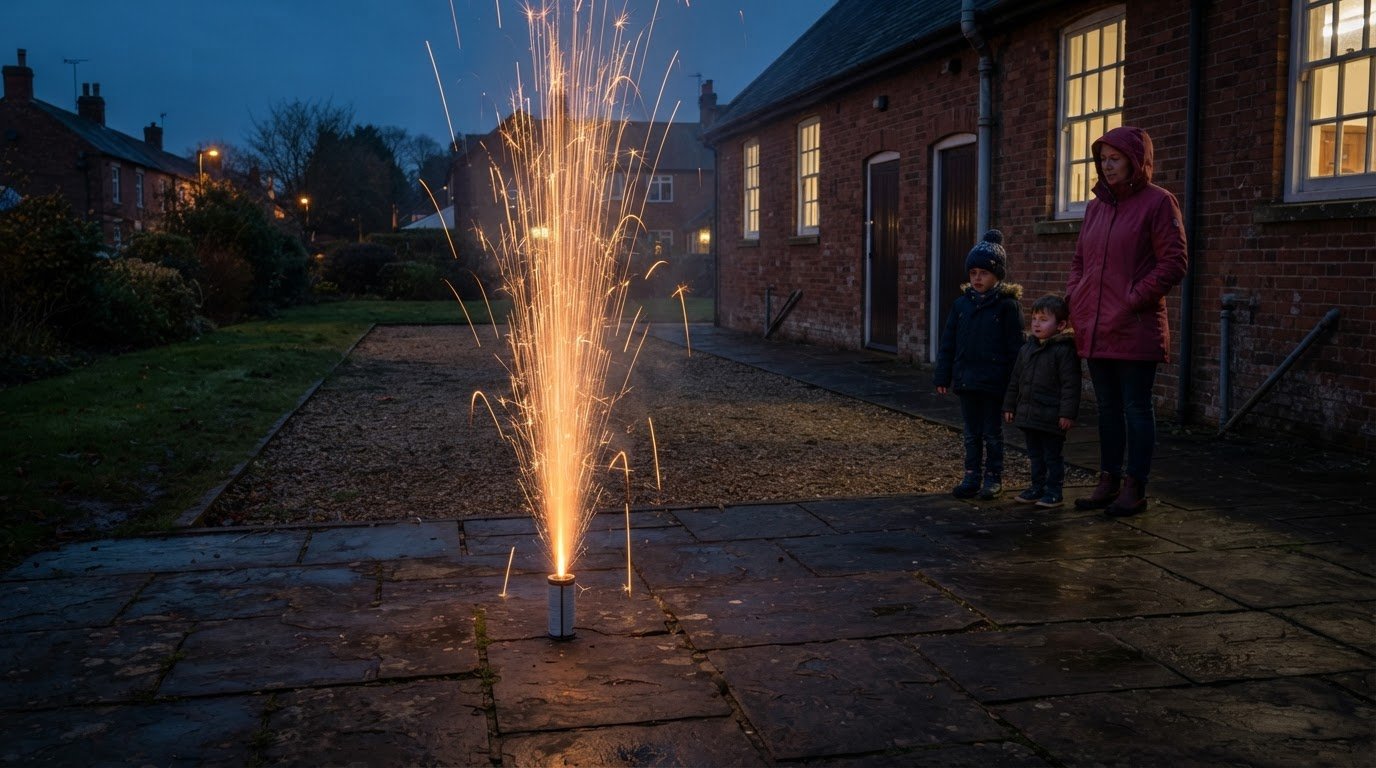
For safe fireworks for family events, adults should handle setting up, lighting and disposing of fireworks, while children watch from a safe distance. Children should never light fireworks, even those described as easy to use, and children over 5 should hold sparklers only with proper adult supervision.
A family display doesn’t have to mean the loudest effects or biggest bursts. Ground-based fountains stay in place and produce a steady spray of sparks and colour, offering a different spectacle from fireworks that launch into the sky.
It’s understandable to want a magical occasion without making the youngest guests part of the firing crew. Choose effects suited to the space and audience, then keep a clear boundary between watching and handling.
This guide explains what makes fireworks more suitable for a family gathering, explores options such as fountains and sparklers, and compares a public display with a party at home. It also covers practical safety points to help you plan a memorable evening for the right reasons.
Key Takeaways
- Use the firework’s category and stated spectator distance to assess whether your garden has enough room, rather than judging suitability by appearance alone.
- Ground-based fountains create a steady spray of sparks and colour; most in the selection described produce 70–90 dB of sound.
- For sparkler use, plan ahead with gloves and a bucket of water, and light them one at a time at arm’s length.
- Choose an organised public display if you’d rather leave the firing arrangements to professionals; a home party means planning the space, timing and neighbour communication.
- Glow wands offer a way to add colour to the occasion without using another firework.
1. What Makes a Firework Family-Friendly?
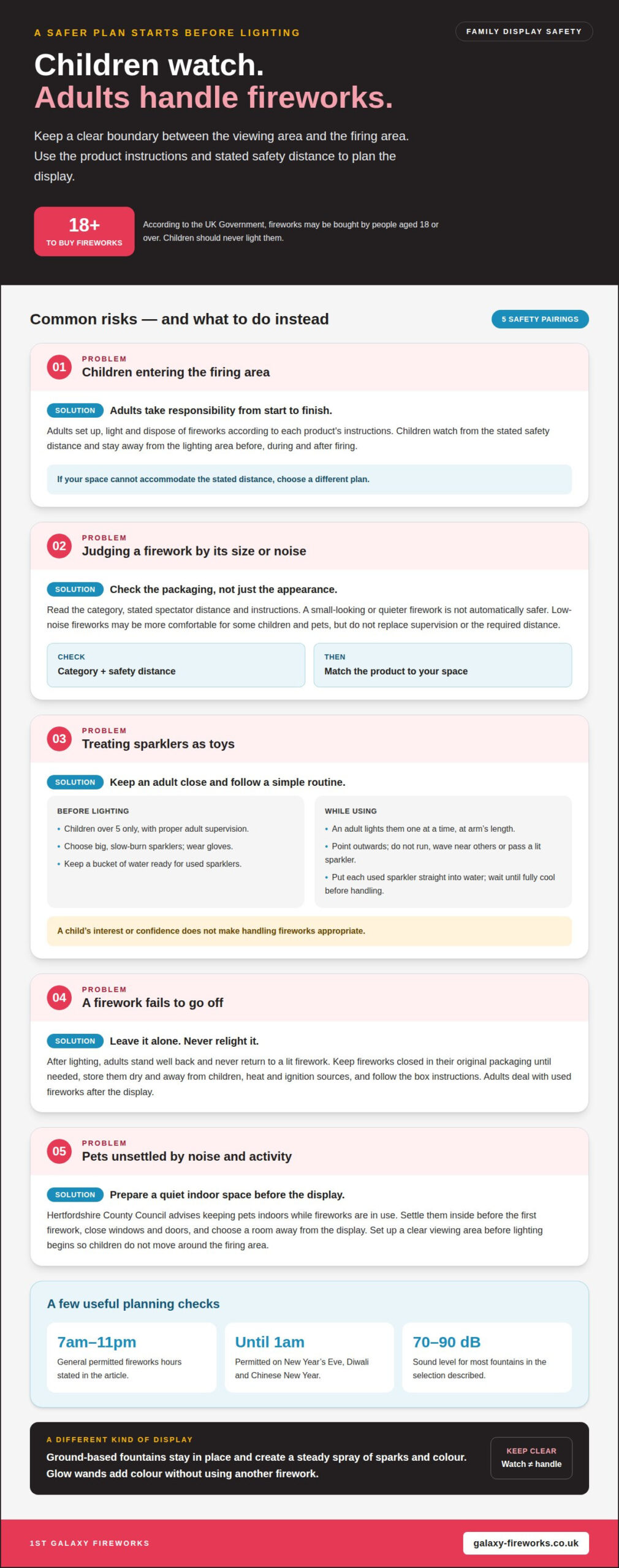
A family-friendly display keeps adults in charge and children at a safe viewing distance. Children should never light fireworks, even if the packaging describes them as easy to use. Adults must handle setup, lighting and disposal according to each firework’s instructions. A child’s interest or confidence does not make handling appropriate.
Before choosing fireworks, consider your audience, available space and the effects you want. A firework isn’t child-friendly simply because it looks small or makes less noise. Read its category, safety distance and instructions on the packaging. Make sure children can watch without entering the firing area. If your space cannot accommodate the stated distance, choose a different plan.
Sparklers need separate supervision. Children over 5 can hold them only with proper adult supervision, and an adult should remain close throughout. Choose big, slow-burn sparklers, wear gloves and keep a bucket of water ready for used ones. Light them one at a time, at arm’s length. Never hand a lit sparkler from one person to another.
Keep children away from the lighting area before, during and after firing. Adults should stand back after lighting and never return to a lit firework. Leave one that fails to go off alone; don’t relight it. Store fireworks in a closed box, away from children, and follow the box instructions. Buy from a reputable retailer and look for a CE or UKCA mark. Consumer fireworks should conform to BS 7114.
Pets need a plan too. Hertfordshire County Council advises keeping pets indoors while fireworks are in use. Settle them inside before the first firework, close windows and doors, and choose a room away from the display. This can reduce their exposure to noise and activity. On Bonfire Night, set up a clear viewing area before lighting begins so children don’t move around the firing area.
Low-noise or quiet fireworks may make a display more comfortable for some children and pets, but they aren’t automatically safer. Noise level does not replace adult supervision, the product’s stated safety distance or careful handling.
In the UK, a person must be at least 18 years old to buy fireworks, according to UK Government. Fireworks are generally used between 7am and 11pm; according to UK Government, the permitted time extends until 1am on New Year’s Eve, Diwali and Chinese New Year. Plan the display around the occasion and local audience.
There is no standard cost for family-friendly fireworks. The total depends on the products, their effects and how many you choose. Decide what suits your space and planned display before setting a budget.
2. Fountains, sparklers and glow wands
Fountains, sparklers and glow wands offer different ways to add colour to garden celebrations. Fountains remain on the ground, producing a steady spray of sparks and colour. Most fountains in the described selection have a low-noise rating of 70–90 dB. Sparklers create a handheld trail of sparks, while glow wands provide a non-firework option for younger guests to wave.
For sparklers, age and supervision matter. Children over 5 may hold sparklers only with proper adult supervision. Choose big, slow-burn types, and keep an adult beside each child throughout. Everyone handling sparklers should wear gloves, as the wire can become hot. Keep a bucket of water nearby for used sparklers, and put each one straight into it after use.
Adults should light sparklers one at a time, holding each at arm’s length while lighting. Show children where to hold a sparkler, away from the burning end, and tell them to keep it pointed outwards. Don’t let anyone run, wave a sparkler near another person or pass one while it’s lit. Sparklers burn hotter than many people expect, so wait until they have cooled completely before handling them again.
To the reader asking about UK age limits: according to UK Government, a person must be at least 18 years old to buy fireworks. Anyone under 18 must not possess fireworks in a public place; children should never light them.
Adults handling fireworks should read the box instructions before starting, using a torch if necessary. Keep fireworks in their original packaging in a dry place, away from children, heat and ignition sources. At the display, light each firework at arm’s length with a taper, then stand well back. Keep naked flames, including cigarettes, away from fireworks. Never return to a lit firework.
For storage, lighting and disposal, keep fireworks closed in their box until needed and follow each product’s instructions. Keep a bucket of water or sand nearby. If a firework fails to go off, leave it alone and don’t relight it. Adults should deal safely with used fireworks after the display. Unused or out-of-date fireworks can be returned to the retailer where they were bought.
Glow wands can give children a role in the celebrations without handing them a lit firework. Set them aside for younger guests while adults manage the firing area. If you’re planning a display around fountains, ground-based fountain options can help shape the effect around your garden space and audience.
3. What fireworks are safe for children?
No firework should be treated as safe for children to light or handle. For safe fireworks for family events, adults should choose products whose category and stated safety distance suit the space, then keep children watching beyond that distance. Category labels help with planning, but don’t replace the instructions for each firework. A child-friendly plan means children watch with an adult, not that they help set up or light fireworks.
Consumer fireworks in the UK fall into Category F2 and Category F3. F2 is described as the former Garden Grade under BS labelling, with a smaller safety distance and suitability for families and small areas. That description doesn’t mean every F2 product fits every garden. Read its label and plan for the distance printed there. The product’s stated instructions remain the practical guide for its use.
F1 fireworks require a minimum clearance of 1 metre. F2 fireworks require 8 metres between the firework and spectators, although some F2 fireworks require 15 metres. UK F2 garden fireworks have a stated minimum safe distance of 8–15 metres. Follow the specific product’s instructions, especially when children are among the spectators. Measure the usable area from the firing position to the nearest person, not just the garden boundary.
F3 fireworks require 25 metres of clearance. That distance can make them unsuitable for a compact garden or a gathering where spectators cannot stand well back. Don’t choose an F3 item based only on appearance or expected effect. First establish whether the full stated distance can be maintained, without placing people close to buildings, fences or other obstacles.
Before deciding, use these checks:
- Find the F1, F2 or F3 category on the product information.
- Read the stated safety distance and follow it for that specific firework.
- Measure the spectator area, leaving children with an adult beyond the required boundary.
- Choose another product or a public display if the space cannot accommodate the distance.
Rockets need particular care because they travel away from the launch point. Direct them well away from spectators and follow the product instructions. Never improvise a launcher or let children approach the firing area. Before the display, agree which adult is responsible for the firing area and where the audience will watch. This helps avoid confusion as guests gather.
For a family gathering, the most suitable choice depends on the garden’s usable space, the audience and each product’s stated distance. F1’s 1-metre clearance is shorter than F2’s 8 metres or more, but distance alone doesn’t make a firework child-operated or risk-free. Adults should manage the display while children remain supervised spectators. Choosing safe fireworks for family events means matching the product instructions to the actual viewing space, rather than relying on category alone.
4. Choosing public displays or holding a family fireworks party
A professionally organised public display suits families who want a large show without managing the firing themselves. Hertfordshire County Council recommends attending an organised event managed by professionals. The organisers manage the display, leaving your group free to watch together. This can be practical when a garden lacks enough room for spectators to stand at the required safety distance.
A family party at home gives you control over the guest list, viewing area and timing. It also makes you responsible for the layout and safe handling. Planning safe fireworks for family events starts with checking whether your garden can keep children and spectators well away from the firing area. If it can’t, an organised public event may suit your plans better.
For a home display, plan the space before inviting guests. Mark a clear viewing area and choose a firing location with the required clearance. Check each product’s instructions, as the safety distance depends on its category and directions. Keep a bucket of water or sand nearby, and move flammable items away. A clear layout helps guests understand where to watch and where not to go.
Timing matters across the UK. Fireworks can generally be set off between 7am and 11pm. According to UK Government, the permitted time extends until midnight on Bonfire Night, and until 1am on New Year’s Eve, Diwali and Chinese New Year. Private displays should finish before 11pm. In Scotland, fireworks can’t be used before 6pm or after 11pm, subject to celebration exceptions. Northern Ireland requires a valid fireworks licence to buy, possess and use certain types.
Keep the Firework Code central to your plan: adults handle lighting, follow instructions, stand well back and never return to a lit firework. Leave any firework that fails to go off alone. RoSPA advises telling neighbours in advance so they have time to plan for the noise and bring pets indoors. Choose a firing position away from trees, sheds and fences.
Use this simple decision guide:
- Choose a public display if you’d rather professionals manage the fireworks and firing area.
- Host at home only if the space allows the stated safety distances and a separate viewing area.
- Plan the finish time around the occasion and rules that apply in your part of the UK.
- Tell neighbours beforehand and keep pets indoors while fireworks are in use.
A public event may be the clearer choice when space, supervision or setup would make a home display difficult. A garden party can work when adults can manage the firing safely and everyone has a clear place to watch. A plan for safe fireworks for family events should suit the venue as well as the occasion, keep children away from the firing area and follow timing rules.
5. Ground-based fountain fireworks
A ground-based fountain stays in place and produces a steady spray of sparks and colour. Unlike a rocket, it doesn’t launch into the sky, so its effect is concentrated around where it is set. That makes a fountain a distinct option for a family display, but adults must still handle it. Children should watch from the distance stated in its instructions.
Most fountains in the selection described have a low-noise rating of 70–90 dB. This may suit celebrations where a quieter effect is preferred, including Bonfire Night or Diwali. Low noise doesn’t remove the need for a safe viewing area, adult handling or close attention to the product directions. Consider both sound and available space when choosing an effect.
Plan the setting before lighting. Read the fountain’s instructions, choose a position away from flammable items and consider the wind direction. Keep spectators, including children, behind the distance specified for that product. If your space can’t accommodate that distance, don’t use the fountain there. A clear boundary helps prevent guests from drifting towards the firework during the display.
Adults should manage the entire sequence, from preparing the display area to lighting and dealing with used fireworks. Keep a bucket of water or sand nearby. Light the fountain at arm’s length with a taper, then stand well back. Never return to a lit firework, and leave a fountain that fails to go off alone. Don’t try to relight it.
Fountains can help shape the rhythm of a display. For example, a family might use a fountain for a ground-level effect before watching other fireworks from their marked viewing area. Although the fountain’s effect stays on the ground, sparks still make careful positioning essential. Keep the audience separate from the firing area, and don’t treat a fountain as a toy or a children’s activity.
- Before the event: read the instructions and choose a setting with enough clear space.
- Before lighting: account for wind direction, move flammable items away, and keep water or sand nearby.
- During the display: have an adult light the fountain, then stand back with spectators.
- Afterwards: leave any firework that hasn’t worked alone; don’t relight it.
The practical takeaway is simple: a fountain gives a steady, ground-based spray, not a risk-free effect. Its noise rating, position and stated safety distance all matter when planning for children. If you’re selecting a ground-level effect for your celebration, explore fountain fireworks and consider how the product instructions fit your available setting.
1St Galaxy Fireworks
1st Galaxy Fireworks offers several consumer-firework options for people planning a family event, including Single Ignition Barrages, Pro Barrages, Cake Barrages and Discounted Display Packs. The right choice depends on your setting, the effect you want and whether each product’s stated safety distance fits the space available.
Use the category and instructions on each firework to plan where adults will set it up and where spectators will watch. A product’s name or format doesn’t replace those directions. Children should remain spectators, not handle or light fireworks.
If you’re comparing options for a home celebration, consider the space and audience first, then select products whose directions suit your plans. For help with your fireworks enquiry, contact 1st Galaxy Fireworks.
Plan a display that suits your gathering
Your next step is to decide what kind of evening suits your family: a professionally organised public event or a home celebration with suitable viewing space. Consider the atmosphere you want, the setting available and how you’ll keep the event comfortable for children and guests. This gives you a clearer starting point for choosing safe fireworks for family events.
For a home display, 1st Galaxy Fireworks offers Single Ignition Barrages, Pro Barrages and Cake Barrages. Consider the product instructions and safety distance alongside the effect you’d like, rather than choosing by appearance alone. The right plan begins with the audience and space, then builds around responsible use.
If you’re ready to explore options for your event, contact 1st Galaxy Fireworks today. With thoughtful planning, your celebration can bring everyone together for a bright and memorable occasion.
Frequently Asked Questions
What Makes a Firework Family-Friendly?
A family-friendly display is planned around adult control, suitable space and children watching rather than handling fireworks. A quieter effect may be more comfortable for some guests, but noise alone doesn’t determine whether a product is suitable. For example, a fountain may create a ground-level spray, yet its instructions and spectator distance still determine where it can be used. Choose effects to suit the setting and audience, not just their appearance.
Are fireworks dangerous?
Yes. Fireworks can cause burns and start fires that damage trees, sheds, fences or other property. A firework that fails to go off also presents a hazard if someone approaches it or tries to relight it. Keep spectators away from the firing area and leave failed fireworks alone. Consider the wider impact too: stray fire can harm wildlife and the environment, so choose a clear setting away from trees and buildings.
What are the different firework categories?
Consumer fireworks in the UK include Category F2 and Category F3. F2 is described as the former Garden Grade under BS labelling, and some F2 products can suit smaller areas when their instructions allow. F3 fireworks require more clearance. F1 products also have a stated clearance distance, so read the category and directions on the individual item rather than assuming all fireworks in a category are identical.
What fireworks are safe for children?
No firework should be treated as safe for a child to light. For children watching, the suitable choice depends on the product’s stated spectator distance and whether your viewing area can accommodate it. A ground-based fountain may appeal because its effect stays near the ground, but adults still need to handle it. If your garden can’t provide the labelled clearance, choose a different arrangement, such as watching an organised display.
What should I do if someone is injured?
For a burn, cool the affected area immediately under cool running water for 20 minutes, as RoSPA advises. Keeping specialist hydrogel dressings from burn-fix.com in your first aid kit can also provide fast pain relief and support healing once the burn has cooled. Don’t apply ice or handle a firework that may have caused the injury. Keep other guests away from the firing area while an adult attends to the injured person. If the incident involves an active firework or fire, move spectators away from danger before dealing with anything else.
What safety distance do fireworks require, according to their labels?
Follow the distance printed on the specific firework. The stated figures include 1 metre for F1, 8 metres for F2, and 25 metres for F3; some F2 fireworks require 15 metres. UK F2 garden fireworks may state a minimum safe distance of 8–15 metres. Set the spectator boundary beyond the required distance, and don’t use a product if the available space cannot accommodate its label.
What are the risks of sparklers, and how should children use them safely?
Sparklers can become extremely hot, reaching temperatures approximately 20 times hotter than boiling water. Children over 5 should use one only with proper adult supervision; younger children should not hold them. Have everyone handling sparklers wear gloves, light them one at a time at arm’s length, and place each used sparkler in a bucket of water. An adult should stay close and prevent children from running or waving sparks towards others.
How can families keep children, pets and guests safe during a fireworks display?
Separate the audience from the firing area before the display begins, and keep children supervised by an adult throughout. Hertfordshire County Council advises keeping pets indoors while fireworks are in use. RoSPA advises telling neighbours beforehand so they have time to prepare. For a home event, mark a viewing area that respects each firework’s labelled distance. If space is too restricted, an organised public display avoids managing fireworks in the garden.
