
Large Single Ignition Firework Boxes for Displays
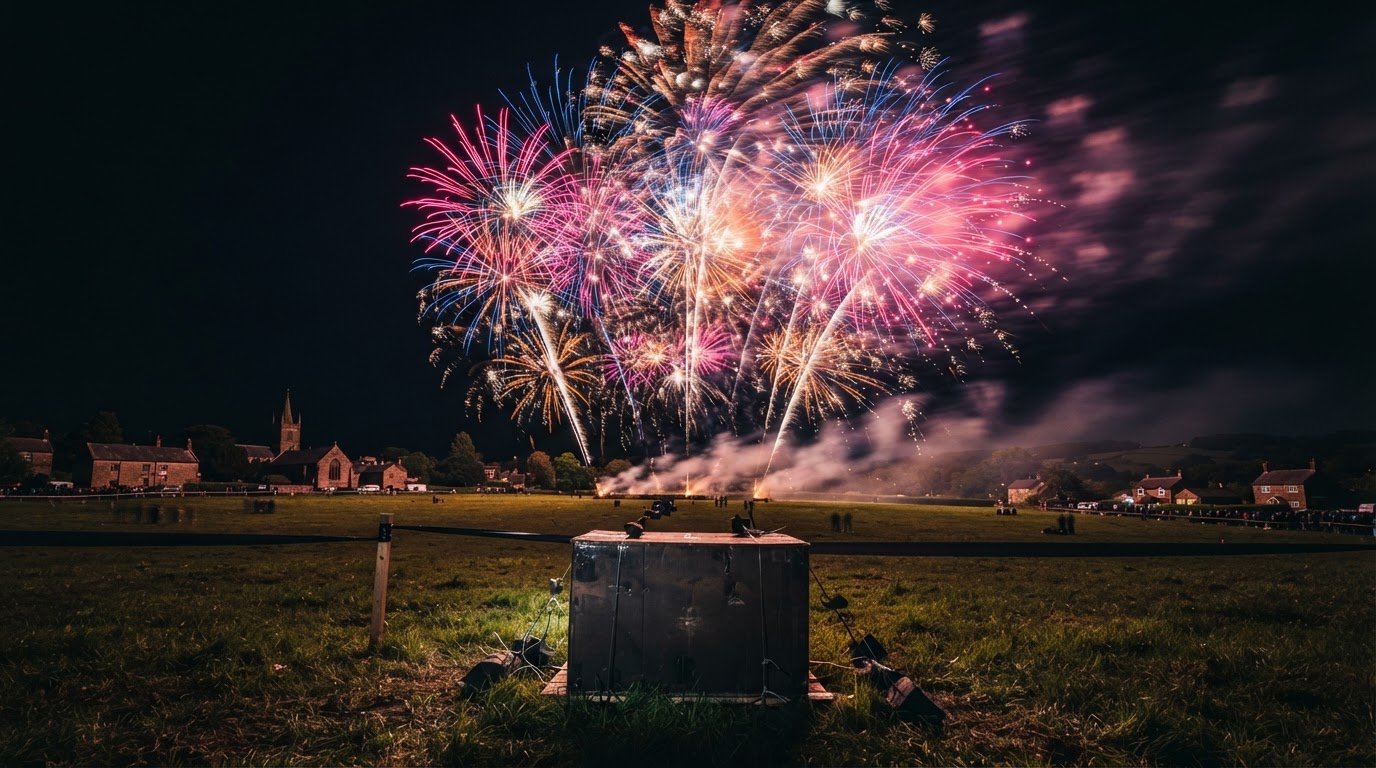
A single-ignition display in this range can run for 1 to 15 minutes, while larger fireworks may last 20 minutes or more. Large single ignition firework boxes can contain dozens or even hundreds of shots, making them a striking centrepiece or a complete display in their own right.
It’s natural to focus on the scale of the effects, but duration and firing pattern matter just as much when planning a display. This guide explains how long different single-ignition fireworks can run, what influences their cost and how their aerial effects compare with cakes. You’ll also learn what to consider when choosing large single ignition firework boxes, so you can match the display to your space, occasion and expectations.
Key Takeaways
- Display duration varies considerably: learn what to expect from smaller fireworks and larger, longer-running options.
- Compare shot count, calibre and firing time to judge which box best suits your display plans.
- Understand how a single-ignition sequence differs from cakes in pacing, variety and overall effect.
- See which practical safety details matter when positioning and lighting fireworks.
- Explore how Single Ignition Barrages, Pro Barrages and Cake Barrages can help shape a display to your needs.
How long do single ignition firework displays last?
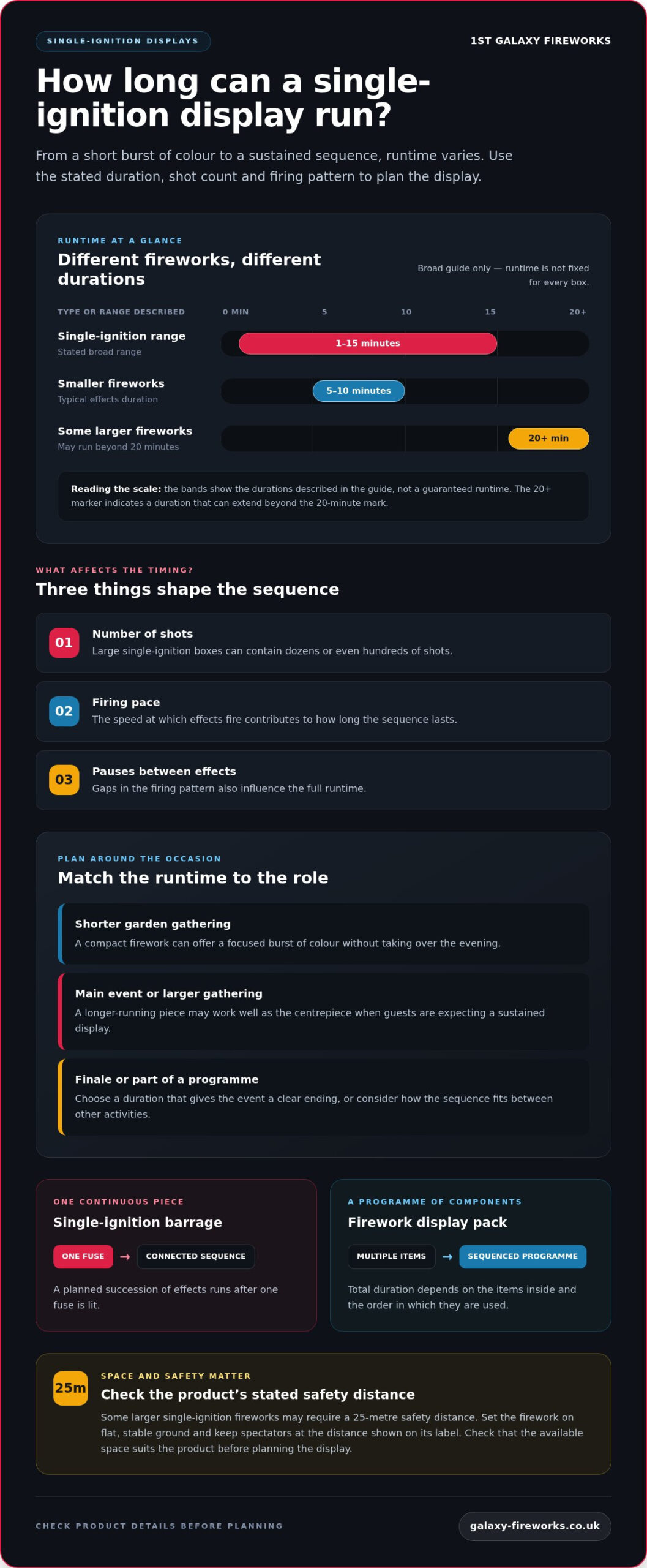
Single-ignition displays in this range can run for 1 to 15 minutes. Smaller fireworks typically produce effects for 5 to 10 minutes, while some larger fireworks can run for 20 minutes or more. These are broad differences, not a fixed runtime for every box. The number of shots, firing pace and pauses between effects all influence the duration. Check the product details before planning your display, and allow enough time for the full sequence.
For a shorter garden gathering, a compact firework can provide a focused burst of colour without taking over the evening. A longer-running piece may work better as the main event, especially when guests are expecting a sustained display. Start with the occasion: a family celebration may call for a brief finale, while a larger gathering may benefit from a longer sequence. Runtime helps you plan the programme, but it doesn’t tell you everything about the effect or scale.
Think about where the display fits in your schedule. If fireworks are the finale, choose a duration that gives the event a clear ending. If they’re part of a wider programme, consider how a single-ignition firework will fit between other activities. A display-in-a-box runs its sequence from one fuse, delivering a planned succession of effects without needing to light separate fireworks during the performance. Read the stated duration alongside the shot count and firing pattern.
A firework display pack offers a different approach: it groups multiple fireworks that you can use to build a longer programme. Its total duration depends on the items inside and how you sequence them, rather than the runtime of one product. By contrast, a single-ignition barrage fires its connected sequence after one fuse is lit. Choose between them based on whether you want one continuous piece or a display assembled from separate components.
For garden displays, available space is a practical deciding factor. Some larger single-ignition fireworks may require a 25-metre safety distance, so compare the product’s stated distance with the garden before buying. Set the firework on flat, stable ground and keep spectators at the distance shown on its label. A stunning sequence is only suitable when the available space and the instructions work together.
In England, Scotland, Wales and Northern Ireland, plan a home display on private land with the occupier’s permission; public-place possession is restricted. Under regulation 4, no person under the age of eighteen may possess an adult firework in a public place, subject to regulation 6, according to UK Government, legislation.gov.uk. That rule concerns possession in a public place. Keep age restrictions and the product’s safety instructions in view when planning who handles the firework.
Product prices
A single-ignition firework’s price reflects more than its shot count. Calibre, firing sequence, variety of effects and overall duration all shape what a box offers. A compact piece designed for a short burst of colour serves a different purpose from a larger box built around a sustained sequence. Compare these features before judging value, particularly when planning a Bonfire Night display.
Start by matching the firework to your event. If you want one centrepiece, consider how its firing time and effects will carry the display. If you’re assembling a programme, compare the box with other elements, such as rockets or smaller fireworks. Your total spend depends on what you choose and how the pieces work together, not just on the number printed on one box.
Shot count can help you compare products, but it isn’t a complete measure of value. For example, a 75-shot compound with 30mm calibre offers a different specification from a 49-shot cake with 20mm calibre. Shot count describes quantity; calibre indicates another aspect of the product’s specification. Read both alongside the stated effects and duration, rather than assuming that more shots always mean a better fit.
Look closely at the sequence, too. One box may build through colour changes, crackle effects and varied firing rhythms, while another follows a more consistent pattern. A firework lasting seconds might suit a brief finale, whereas a longer sequence could anchor the main event. Product descriptions help you compare these differences, so check the effects and firing pattern before deciding where a firework fits in your plan.
Discounts and offers can affect value, particularly when several items are sold together. Compare a pack’s contents with the individual products you might otherwise choose. Check that the selection suits your occasion, available space and preferred effects. A bundle is useful when its contents work together; a reduced price alone doesn’t show whether it meets your display needs.
For a considered comparison, note each option’s shot count, calibre, duration and effect style. Then decide whether you need a single focal point or several components to combine. This makes it easier to compare single-ignition options with rockets or other fireworks without relying on price alone. Browse single-ignition firework options with those details in mind.
Differences between single-ignition fireworks and cakes
The terms can overlap: a single-ignition firework may also be described as a cake. The key distinction is often how the product is assembled and what its firing sequence is designed to do. A standard cake fires a sequence from one fuse, while a single-ignition firework may offer a more varied, choreographed show. Both start with one lighting step, but their effects and pacing can differ.
A compound takes the idea further by linking several cakes inside one box to create a longer display. Instead of lighting each cake separately, the connected contents fire in sequence. This makes a compound different from a single cake, even though both are lit once. Product descriptions can help you distinguish a straightforward run of effects from a larger, connected arrangement.
Consumer one-light cakes bring several effects together behind one fuse, making them a convenient choice for a planned display. They combine straightforward firing with a sequence that can include varied effects. A single-ignition barrage may contain hundreds of shots, while individual cakes can have a more compact run. Compare the product’s shot count, calibre and stated duration instead of relying on its category name alone.
Duration varies across these formats. Single-ignition cakes are described as lasting from 30 seconds to over two minutes; another product description gives a duration of over 50 seconds. Those figures show why the word “cake” alone cannot tell you how long a firework will run. Check the details for each product, then decide whether its timing suits a short finale or a longer sequence.
For use, the box’s safety distance is essential. Some larger single-ignition fireworks may require a 25-metre distance, but the product label gives the instruction to follow. Place the firework on flat, stable ground, light the fuse as directed, then move back to the stated distance. Keep spectators there throughout the firing.
After the sequence ends, don’t approach a spent cake immediately. Wait at least 15-20 minutes before going near it, as advised for a spent single-ignition firework cake. An apparently finished firework may still pose a risk, so keep people away during that waiting period.
In the UK, people under 18 are prohibited from purchasing or attempting to purchase fireworks. Under regulation 4, no person under the age of eighteen may possess an adult firework in a public place, subject to regulation 6, according to UK Government, legislation.gov.uk. For use, follow the firework’s instructions and safety distance.
Aerial effects and firing patterns
With a single-ignition firework, lighting one fuse starts the sequence. The connected shots then fire without relighting each effect, creating a continuous aerial display with bursts unfolding in a planned order. A standard firework cake also fires from one fuse, but its sequence is generally simpler. Single-ignition fireworks are designed for more varied, choreographed shows, so the pattern matters as much as the shot count.
Numbers help describe a product’s scale, but they don’t reveal its full visual character. Spit Crackle Strobe has 64 shots and 16mm calibre; its name signals a crackle and strobe theme. Genesis has 49 shots and 20mm calibre. These details let you compare formats and specifications, whilst the product description explains the effects intended for each sequence. Read both before choosing a piece for your display.
Calibre and shot count also provide useful context for the aerial pattern. Dragon Swarm is listed as a 100-shot single-ignition cake with 30mm calibre, while Berlin has 144 shots and 25mm calibre. Those figures describe different product specifications, not a guarantee of a particular effect or firing pace. Use the stated effect description to understand whether the sequence suits the atmosphere you want.
Compounds offer another kind of sequence: several cakes are linked inside one box to create a longer display. Network Overload, for example, is a 200-shot compound. Gold Fever is a 75-shot compound with 30mm calibre. These examples show why “compound” and “single-ignition” shouldn’t be treated as interchangeable descriptions. One refers to linked cakes; the other describes a firework sequence initiated with one fuse.
Look for the order and variety of effects in the product details. A sequence may move through different colours, bursts or crackle effects, creating contrast rather than repeating one visual style. The firing pattern shapes how those moments feel: closely spaced shots create a brisker progression, while pauses give individual bursts room to register. These distinctions are useful when comparing products, but always follow the description for the specific firework.
To choose a sequence, first decide whether the firework is a centrepiece or one part of a wider programme. Then compare its effect description, shot count and calibre. For instance, a 49-shot product and a 144-shot product offer different shot totals, but the firing pattern determines how those shots are presented. Match the described effects to the mood of your event, rather than choosing on quantity alone.
Large single-ignition firework boxes
Large boxes are defined by their specification, not simply their footprint. Shot count and calibre help show the scale of the contents, while the product description explains the intended effects. Solar Eclipse has 80 shots, Velocity has 224, and Overlord has 100 shots with 30mm calibre. These examples give a useful starting point for comparing the selection, but a higher shot count alone doesn’t tell you how impressive the display will look.
Compare the details side by side. Berlin is a 144-shot single-ignition cake with 25mm calibre, while Dragon Swarm has 100 shots and 30mm calibre. The difference shows why quantity isn’t the only measure: shot count and calibre describe different product features. Use both alongside the stated effects and duration to decide whether a box suits your event’s finale or should sit within a wider display.
Some boxes can form a complete display on their own; others work best as a centrepiece. Think about the finish you want. A larger shot count may mean a longer or more involved sequence, but firing patterns vary by product. Read the product description for its sequence and effects, then consider whether the style suits your occasion. A named example such as Velocity gives you a concrete specification to compare with your space and display plan.
Safety distance is a deciding factor for large fireworks. Some larger single-ignition products may require a 25-metre safety distance. Check the label for the specific distance, and only choose a box if you can position spectators accordingly. Set it on flat, stable ground, then follow the lighting instructions and move back. The available space should guide your selection before shot count or visual ambition.
For consumer fireworks, people under 18 are prohibited from purchasing or attempting to purchase them. These rules address age and public-place possession; they don’t establish a separate licence condition for buying large consumer boxes.
Before choosing, compare shot count, calibre, described effects and the product’s safety distance. For instance, Overlord’s 100 shots and 30mm calibre provide specific details, but the label’s instructions determine how it should be used. If a 25-metre safety distance cannot be maintained, that product isn’t suitable for the available space. Browse large single-ignition firework boxes and use those details to shape a safe, well-planned finale.
1St Galaxy Fireworks: Single Ignition Barrages
1st Galaxy Fireworks offers Single Ignition Barrages for shoppers planning a focused, coordinated firework display. If you’re comparing formats, Pro Barrages and Cake Barrages provide further options, while Discounted Display Packs bring together products for a broader selection.
Choose by considering the occasion, the fireworks’ role in your programme and the available space. Read each product’s effects and safety instructions, then compare the options with your display plan. This makes it easier to decide whether a single barrage, a cake or a pack best suits your finale.
For a closer look at the available options, visit galaxy-fireworks.co.uk.
Shape a display that feels right for your event
Turn the atmosphere you want into a practical shortlist. Decide whether you want one focal moment or a sequence built from several elements, then compare options with your venue, audience and event style. Large single ignition firework boxes can create a defining moment, while combining different formats may suit a programme that builds towards its finale. Keep the product instructions and available space central to your decision.
1st Galaxy Fireworks offers Single Ignition Barrages, Pro Barrages and Cake Barrages, giving you different formats to consider as you plan. If you’d like help choosing a direction for your display, contact 1st Galaxy Fireworks. Take your time, choose with care, and create a finish your guests can enjoy.
Frequently Asked Questions
What do you mean by Single Ignition or Compound?
Single-ignition describes a firework sequence started by lighting one fuse. A compound is one product containing several cakes connected to fire as a longer sequence. The terms describe related but different features: one refers to how firing starts, the other to how multiple cakes are assembled. Check the product description to see whether you’re choosing one cake or linked cakes inside a compound box.
What does a single ignition barrage look like?
A single-ignition barrage produces a sequence of aerial effects after its fuse is lit. Its appearance depends on the effects and firing pattern described for that product, so one barrage may look quite different from another. Check the product details for the intended colours, crackle or other effects. For example, a low-noise cake is described differently from a product whose name highlights crackle or strobe effects.
What is the difference between a barrage and a cake?
The terms can overlap in consumer firework descriptions: a barrage may be made from cakes, and a cake can fire as a sequence from one fuse. “Barrage” often describes a rapid series of shots, while “cake” describes a box containing launch tubes. Use the full product description, shot count and effect details to understand what’s inside, rather than treating the labels as mutually exclusive product types.
What counts as a large single-ignition firework box in the UK?
It’s a boxed firework containing multiple tubes that fire after one fuse is lit. “Large” is a descriptive category rather than a single shot-count threshold, so compare the product’s stated shots, calibre and safety instructions. For example, a 57-shot cake with 20mm calibre and a 144-shot cake with 25mm calibre have different specifications. The label and product details are more useful than box size alone.
How many shots and what effects do large firework boxes contain?
Shot counts vary by product, from dozens to hundreds. For example, Loose Cannon is a 57-shot cake with 20mm calibre, while Velocity is a 224-shot single-ignition cake. Effects also vary: Zodiac is described as a 49-shot low-noise cake with 20mm calibre. Use the product description to identify its effects, then compare the shot count and calibre with the role you want it to play.
How much do large single-ignition firework boxes cost in the UK?
There isn’t one fixed price for this category. The amount depends on the product’s specification, including shot count, calibre, effects and whether you’re considering an individual box or a pack. When comparing large single ignition firework boxes, first decide what your display needs, then review the listed price and contents of each suitable product. A higher shot count alone doesn’t establish better value if the format doesn’t suit your plan.
How can you safely set up and light a large firework box?
Follow the instructions supplied with the specific firework. Choose a clear, level position, set the box on flat, stable ground and make sure it cannot topple. Keep the required safety distance and spectators clear before lighting the fuse as directed, then move back immediately. Don’t return to a firework that fails to function. Follow the label’s instructions for handling it and keep the area clear.
What are the main risks and safety distances for large firework boxes?
Fire, burns, falling debris and a firework tipping over are hazards to consider. The required safety distance depends on the product, and some larger single-ignition fireworks may require 25 metres. Treat the distance printed on the box as the instruction for that firework, not a figure to estimate. Check that the site allows spectators to remain clear throughout the display, and don’t use a product where its stated distance cannot be maintained.
