
Catherine wheels for gardens: sizes, safe fitting and display time
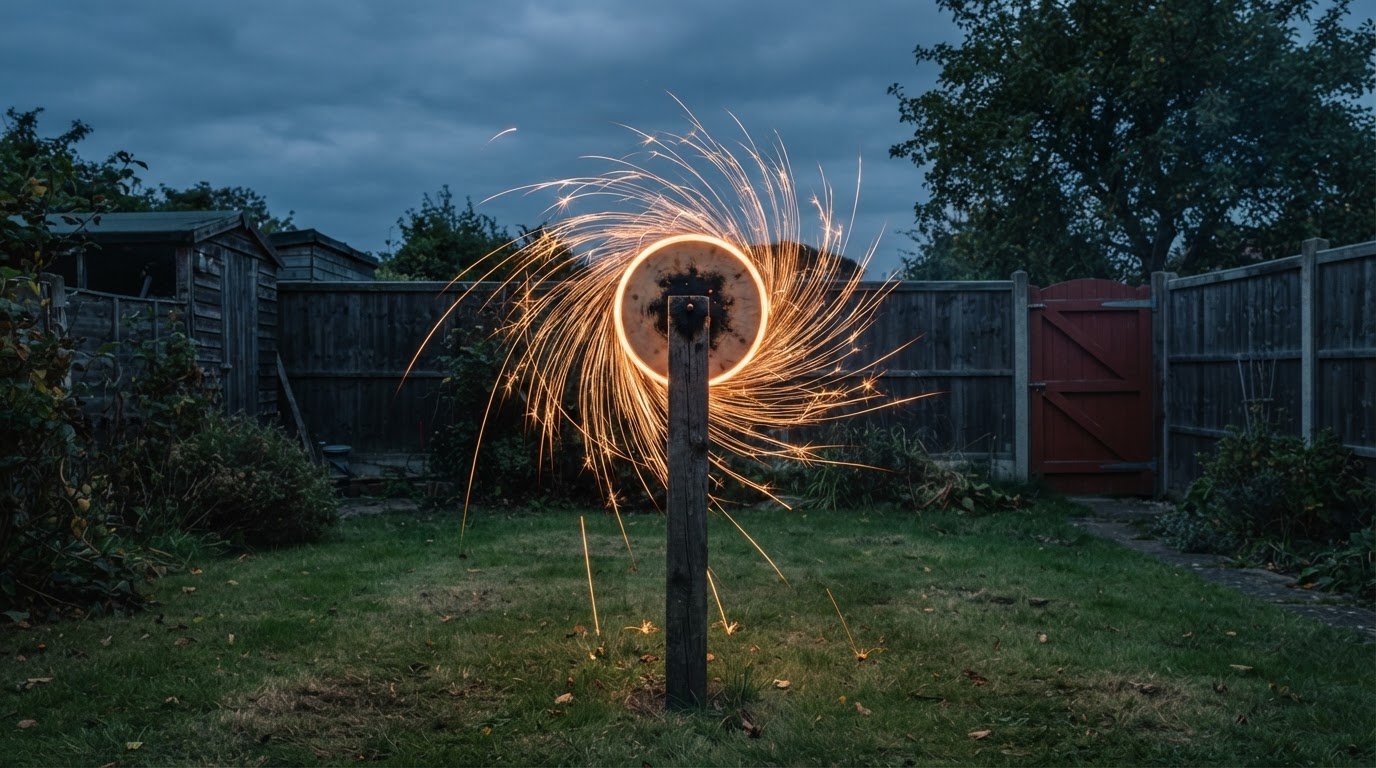
Catherine wheels for garden display are still available in the UK throughout the year. Standard versions have no bang charge, so their sound is generally the rush of spinning sparks, and display times range from around 30 seconds to over two minutes. The right choice depends on the effect you want and the space you can use safely.
It’s easy to focus on a wheel’s size or sparkle, but its mounting position and the space around it matter just as much. It needs a firm, suitable support and clear space for sparks to travel outwards.
This guide explains how to choose and mount a wheel safely, keep it clear of fences, sheds and trees, and plan for its noise and burn time. You’ll also learn how to use the stated safety distance for your firework category to judge whether it will fit your garden display.
Key Takeaways
- Catherine wheels are still available in the UK, and their spinning sparks usually make a softer sound than fireworks with a bang.
- Choose a wheel to suit both the garden’s available space and the effect you want, taking its stated safety distance into account.
- A sturdy post of its own gives the wheel a more suitable mounting point than a fence or shed; make sure it can spin freely before lighting.
- Display times vary by wheel, so compare the product’s stated duration when planning how it will fit into your display.
- If you want to build a broader fireworks display, 1st Galaxy Fireworks offers Single Ignition Barrages alongside other barrage options and display packs.
Can you still buy Catherine wheels?
Yes. Catherine wheels for garden display are available in the UK and can be bought and used throughout the year. Their distinctive effect comes from a wheel fixed to a support: when lit, it spins and throws sparks outwards in a circular pattern. That makes placement part of the display, not just a question of where the audience can see it. A clear view matters, but so does keeping the rotating sparks away from people and nearby objects.
Standard versions have no bang charge, so the sound is generally the rush of spinning sparks. The visual effect can change as the wheel turns, with bursts of light around its rim. A Catherine wheel therefore offers a different experience from fireworks whose main effect is a loud report. If you want a quieter-feeling moment in your display, consider how its steady spin will sit alongside other effects, rather than judging it by brightness alone.
Fountains create a different shape of display: instead of spinning horizontally, they send a spray of sparks upwards from a stationary position. The colour and pattern depend on the individual firework’s effects. Read the product description to see whether it features coloured sparks, a varied sequence or a more consistent spray. For example, placing a fountain before a Catherine wheel can shift the display from an upward plume to circular movement, adding variety without relying on one type of effect.
Some fireworks include a whistle, but that isn’t the usual sound of a standard Catherine wheel. Check the listed effects if a whistle is important to your display. The same applies to colour: a bright wheel may create a vivid rotating pattern, while a fountain’s colour comes from its own sequence of sparks. These distinctions help you choose for the experience you want, rather than assuming every product has the same sound or visual finish.
Timing matters too. According to the UK Government, it’s against the law to set off fireworks between 11pm and 7am, except on certain occasions. Plan the display so the Catherine wheel and any fountains fit within the permitted hours. The year-round availability of fireworks doesn’t remove that time restriction. A simple planning step is to decide the display’s running order and finish time before setting anything up.
For a garden display, compare each wheel’s effect description with the available space and viewing angle. A circle of sparks needs room around the device, while an upright fountain needs a clear area above it. Keep the audience’s position in mind as you plan. These differences make Catherine wheels distinctive: their spinning motion creates a different shape and sound from a fountain’s rising sparks or a firework with a whistle.
Choosing wheels for different garden sizes
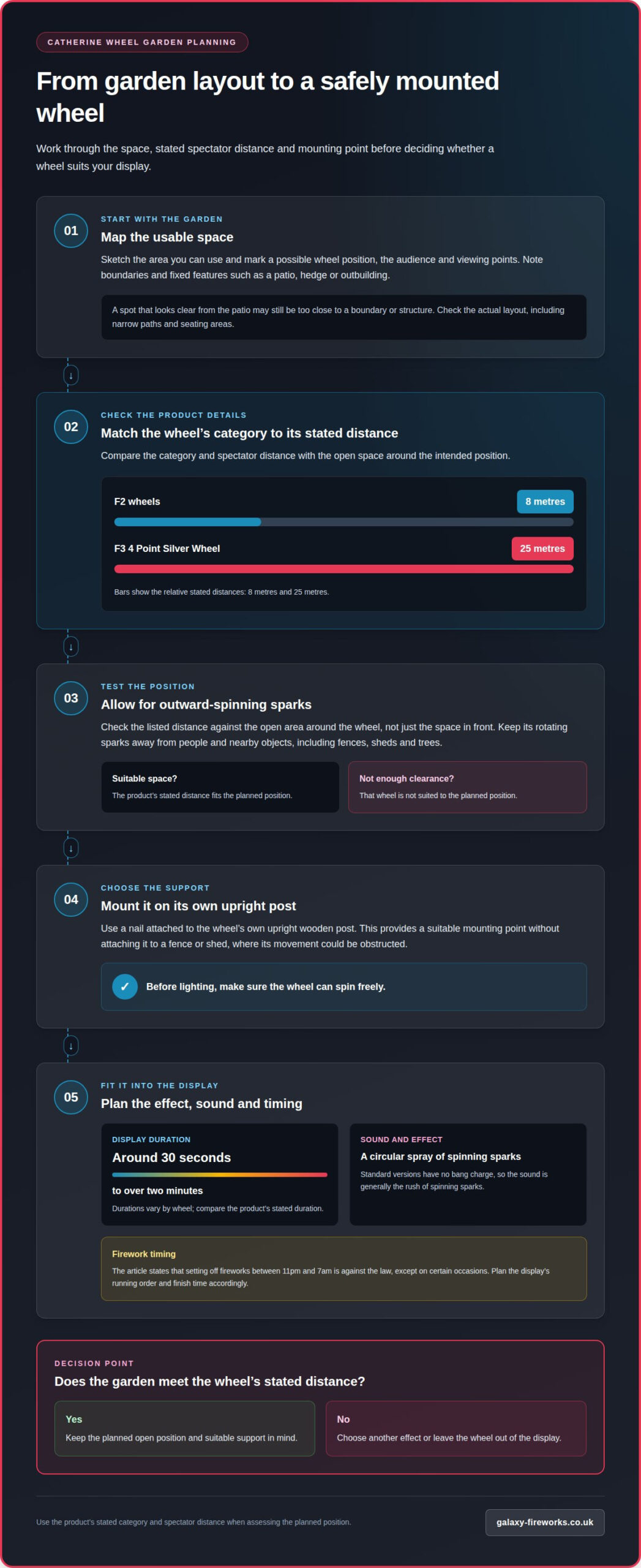
Start with the space available, then match the wheel’s stated spectator distance to the garden. F2 wheels require 8 metres, while the F3 4 Point Silver Wheel requires 25 metres.
Positioning a Wheel in a Display
Positioning means choosing where the wheel sits in relation to spectators, viewing points and other effects. It matters because a spinning wheel sends sparks outwards, so the space around it counts as much as the space in front.
Sketch the garden’s usable area and mark the wheel’s intended position. Then compare the product’s category and safety distance with the open space around that point. For an F2 wheel, allow the required 8 metres; the F3 4 Point Silver Wheel needs 25 metres. If the garden can’t accommodate the listed distance, that wheel isn’t suited to the planned position.
Selecting a Wheel for a Garden
Choose a wheel by balancing its effect and category against the usable space. A smaller garden may have limited clearance, while a larger lawn can offer more options for position and viewing angle.
Read the product description before deciding. Note the category, stated spectator distance and effects, then consider whether the wheel can sit well apart from the audience and other fireworks. Even a bright, prominent effect needs a suitable open area; choosing by appearance alone won’t solve a space constraint. Start with the listed safety distance, not the garden’s overall size.
In a compact garden, note the boundaries and fixed features such as a patio, hedge or outbuilding. Mark a possible wheel position, then check the required separation in every direction. A spot that looks clear from the patio may still be too close to a boundary or structure. If no position meets the product’s stated distance, choose another effect or leave the wheel out.
In a larger garden, use the extra space to plan the viewing angle and sequence. A wheel can change the pace between other effects, but its outward-spinning sparks need their own clear position. Keep the audience’s location in mind when mapping the display, rather than planning only from the launch point. This applies whether one wheel is the focal point or part of a wider arrangement.
Before settling on a product, compare its category and effect description with the actual garden layout. A simple sketch helps reveal pinch points, such as a narrow path or seating area, that a rough estimate might miss. You can explore Catherine wheel options while considering which type fits the space and display you have in mind.
Mounting wheels safely away from fences, sheds and trees
A Catherine wheel rotates on a fixed support, sending sparks outwards as it burns. Its post, clearance and free movement all matter when choosing a safe position.
UK buyers can buy and use Catherine wheels throughout the year without a licence or training. According to the UK Government, it’s against the law to set off fireworks between 11pm and 7am, except on certain occasions.
Mounting and Setting Up a Wheel
Mount the wheel on a nail attached to its own upright wooden post. This lets it turn freely without attaching it to a fence or shed, where its movement could be obstructed.
Set the post firmly in position, then place it away from trees, buildings and spectators. The recommended mounting height is about 1.5 metres, roughly head height. Leave about 3-4 cm of nail protruding so the wheel can sit on it and rotate. Follow the product instructions for the particular firework.
Before lighting, check that the wheel spins freely on the nail and isn’t pressed against the post. A tight fit can stop it rotating, while an unstable support can shift during use. Use a post dedicated to the wheel, not a fence panel or shed wall, and leave the required clearance around the spinning sparks.
Fire and Injury Risks
The main risks are burns or injury from outward-flying sparks, and fire if sparks reach combustible material. Keeping spectators at the product’s stated safety distance and removing nearby flammable items helps reduce those risks.
Required distance depends on the firework: F2 Catherine wheels require 8 metres, while the F3 4 Point Silver Wheel requires 25 metres. Keep that space clear on every side, not just between the wheel and its audience. Fences, sheds, trees and dry garden material can all restrict where sparks travel or leave objects exposed.
Check the garden before setting up. Remove loose combustible items from the wheel’s immediate surroundings, keep the audience outside the stated distance, and position the post so sparks won’t be directed towards people or property. If the available space can’t provide the required clearance, don’t use that wheel there.
If a Catherine wheel fails to ignite or stops spinning, don’t approach it immediately. Wait at least 15 minutes before going near a firework that has failed to ignite, then follow the product’s safety instructions for handling it.
Before lighting, check that the post is upright, the wheel turns freely and the required space is clear. These checks address the key risks, while the product’s instructions specify its setup and safe distance.
Burn times and noise levels
A Catherine wheel’s burn time depends on its size and the number of drivers producing its effects. Most spin for around 30 seconds, while larger wheels can last over a minute. Listed burn times vary across the range. Check the individual product description: a broad category average won’t tell you exactly how long one wheel will run.
Standard Catherine wheels have no bang charge, so their sound is generally the rush of spinning sparks. That gives them a different character from fireworks designed around a loud report. Fountains create an upward spray rather than a rotating pattern, while a wheel’s effects move around its centre. These are differences in sound and visual form, not a promise that every product has identical effects.
Duration helps determine where a wheel fits in your display. A brief effect can create a clear transition between longer fireworks; a wheel lasting over a minute holds attention for longer. Think about the pace you want, rather than treating the longest burn time as automatically best. A single 30-second spin may be enough to provide a distinct moment, while a longer wheel can support a more sustained sequence of changing sparks.
Use the product’s stated duration to plan the running order. If you place a wheel between two other effects, allow its full listed time before the next begins. That gives viewers time to follow the rotation and watch the effect develop. For example, a short wheel can introduce a new visual pattern, while a longer one can take centre stage in that part of the display.
Burn time and noise are separate considerations. A longer-lasting wheel isn’t necessarily louder, and its sound depends on the firework’s effects. With standard wheels, expect the rush of sparks rather than a bang charge. When comparing options, read the duration and sound description separately instead of using one to judge the other.
Catherine wheels create a rotating display of sparks and are generally heard as a rush rather than a bang, though the exact sound and duration vary by product. Fountains produce an upward spray, so the visual effect differs, while the specific sound and burn time depend on each firework. Use each product’s stated duration when deciding how it fits into the sequence.
Before choosing, consider the display’s intended pace, the audience’s view and the effect you want to lead into. A shorter wheel can punctuate a sequence; a longer one gives its rotation more time to unfold. Use the listed burn time for planning, and the product description to understand the sparks, colours and other effects.
Catherine wheel display duration
A wheel’s listed duration tells you how long its effects run after ignition, not how long the whole display lasts. Product examples show a wide spread: In A Spin Wheel is listed at 20 seconds, Fantasia Wheel at 45 seconds, and Carousel Wheel at 55 seconds. Those figures make duration a practical choice, not a minor detail.
For a brief accent, a 20-second effect can add a quick change of pace between longer fireworks. A 45-second wheel gives its rotation more time to develop, while a 55-second effect can hold attention for longer. The best fit depends on the rhythm you want and how much space the wheel’s effect occupies in the running order.
Plan the sequence around the stated burn time. Put a shorter wheel where a concise visual transition works; place a longer one where the audience can focus on its changing pattern. For example, a 20-second wheel could mark a shift between two parts of a display, while a 55-second wheel could provide a more sustained focal moment. Avoid scheduling another effect to begin before viewers have had time to take in the wheel.
Duration alone doesn’t describe the whole experience. A wheel may spin continuously, or its effects may change as it turns; the product description explains what viewers will see during the listed time. Compare both duration and effect sequence. Two wheels with different running times can create distinct pacing, even though both spin in a circle.
For a small, carefully timed display, a shorter duration can be easier to fit between other effects. A longer wheel may suit a section intended to feel more deliberate. Match the listed time to the surrounding fireworks instead of automatically choosing the longest option. This helps avoid quiet gaps or a rushed sequence and gives each effect a clear role.
The listed duration also helps set expectations with guests. It indicates whether a wheel offers a quick flourish or a longer passage of sparks, although the full display includes setup and the time between effects. Build the running order from each product’s stated time, then allow enough separation for the visual sequence to remain clear. The overall display length depends on the full selection and arrangement, not one wheel alone.
Compare the Catherine wheel options by their listed effects and duration, then choose the one that suits the moment you want to create. A clear running order turns a single wheel’s burn time into a purposeful part of the garden display.
1St Galaxy Fireworks: Single Ignition Barrages
1st Galaxy Fireworks offers Single Ignition Barrages for people who want a coordinated sequence of effects from one ignition. They can complement a Catherine wheel when you’re planning a broader garden display and want more than one style of firework. Pro Barrages and Cake Barrages provide further barrage options, while Discounted Display Packs bring together fireworks for a planned occasion.
Choose an option based on the kind of sequence you want and the space available, then consider how its effects will sit alongside the wheel’s rotation and display time. For weddings or corporate events, 1st Galaxy Fireworks also offers Wedding Fireworks and Corporate Fireworks.
For help exploring the available options, contact 1st Galaxy Fireworks or visit galaxy-fireworks.co.uk.
Shape a display that feels like your own
Planning Catherine wheels for a garden display gives you a chance to create a distinctive visual rhythm. Consider what you want guests to remember: one striking effect or a sequence that builds towards a shared finale. A good plan suits the occasion and gives every firework a clear purpose.
If you’re developing the wider sequence, 1st Galaxy Fireworks offers Single Ignition Barrages, Pro Barrages and Cake Barrages. These can help you explore different ways to shape the display around the wheel, rather than treating each effect as a separate choice.
Contact 1st Galaxy Fireworks for advice as you plan your display. With a thoughtful choice of effects and a clear vision, you can create an evening that feels memorable from its first spark.
Frequently Asked Questions
How much do they cost?
The price depends on the wheel’s size, duration and effects. A simple spinning effect and a larger wheel with several changing effects are different products, so compare their descriptions rather than choosing by appearance alone. Consider what the stated duration and effect sequence offer, then weigh that against the space available. The product’s category and required safety distance matter too, as they determine whether it suits your garden.
What happened to all the really big wheels?
Large Catherine wheels haven’t disappeared entirely, but they’re less practical for many domestic gardens. The F3 4 Point Silver Wheel, for example, has a 25-metre spectator distance. That clearance can rule out a wheel in a smaller garden, even if the effect appeals. Consider the available space first, then look at larger wheels only if you can accommodate their stated distance and position them appropriately.
Why aren’t there many wheels for sale now?
Catherine wheels are available in the UK throughout the year, though designs can vary between ranges. Their mounting requirements make them a more particular choice than fireworks placed directly on the ground: each wheel needs a suitable support and room for its spinning effect. When comparing options, look at the product description and required clearance, not just its size or appearance.
What are Catherine wheel fireworks and how do they work?
A Catherine wheel is a firework designed to spin around a fixed mounting point while producing sparks and visual effects. Its rotation creates a circular pattern, unlike a fountain’s upward spray. In standard versions, the sound is generally the rush of spinning sparks rather than a bang charge. The product description gives the specific effects and duration, which can differ between wheels.
Which Catherine wheel fireworks are suitable for a garden display in the UK?
A suitable wheel is one whose stated spectator distance fits the clear space in your garden. F2 wheels require 8 metres, while the F3 4 Point Silver Wheel requires 25 metres. Check the category and safety instructions for the individual firework before deciding. A wheel isn’t suitable for your chosen position if fences, buildings, trees or the audience prevent you from maintaining its required clearance.
How much do Catherine wheel fireworks cost in the UK?
There’s no single price for every Catherine wheel in the UK. The cost varies by product, including its size, number of effects and listed duration. Compare these details to understand what distinguishes one wheel from another. A longer display or more elaborate sequence may suit a different role in your running order than a brief, simple effect. Choose according to the effect and space you need, not price alone.
What is the minimum safe distance for a Catherine wheel firework?
The minimum distance depends on the wheel’s category and instructions. F2 Catherine wheels require 8 metres, while the F3 4 Point Silver Wheel requires 25 metres. Treat the distance on the individual firework’s instructions as the deciding figure, and keep spectators outside it. Measure the usable space around the planned position, since sparks travel outwards rather than only towards the audience.
How do you securely mount and light a Catherine wheel firework?
Mount the wheel on a nail at the top of its own upright post, not on a fence or shed. A recommended height is about 1.5 metres, with 3-4 cm of nail protruding. Before lighting, check that the wheel spins freely and the post is stable. Follow the product’s lighting instructions and keep spectators beyond its stated safety distance. If it fails to ignite, wait at least 15 minutes before approaching.
