
Pyrotechnics for product launches: preview effects and themes
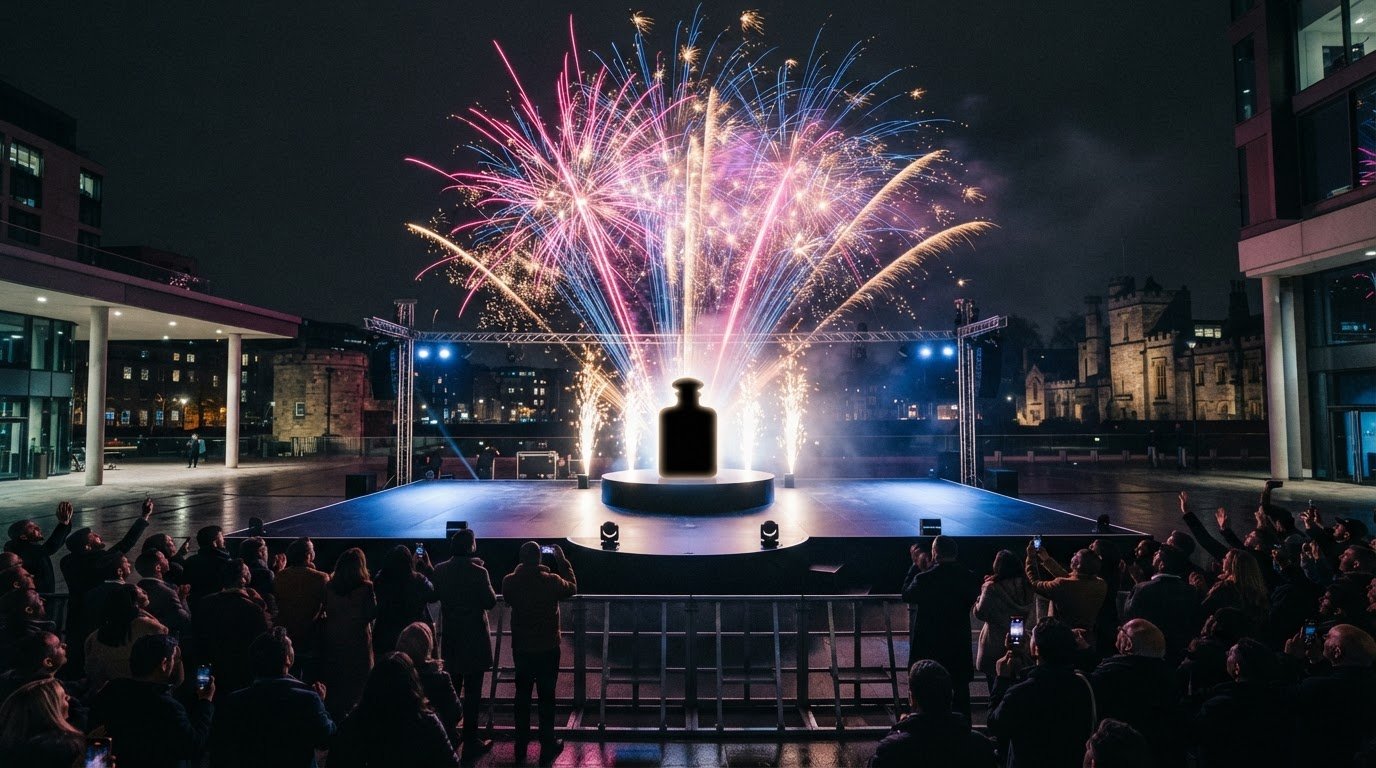
A striking launch display is easiest to picture as a timed visual plan: match each moment with an effect, colour palette and soundtrack cue, then align the sequence with the product reveal. Pyrotechnics for product launches can add a powerful visual punctuation mark, but the venue, audience position and safety arrangements determine what is practical. A clear preview helps everyone understand the intended impact before decisions are made.
It’s natural to want the display to feel unmistakably connected to the brand, not like a spectacle added at the last minute. This guide explains ways to present the concept in advance, choose effects and themes that support the launch, and plan around UK safety rules, qualified operators, suitable venues and booking lead times. You’ll also see how to think about colour, timing and scale so the final sequence complements the product moment rather than competing with it.
Key Takeaways
- Preview the display as a timed sequence of effects, colours and launch moments so the creative team can picture how it supports the product reveal.
- Choose a theme and effects to suit the brand and venue; remember that a firework colour palette can guide the look, but exact shades may vary.
- Venue layout, audience position and the surrounding buildings all influence which effects are suitable and how the display can be planned safely.
- Professional displays are advised to be booked 3 to 6 months ahead, leaving time to plan the site, permissions and practical arrangements.
- For a product-led display using consumer fireworks, 1st Galaxy Fireworks’ Single Ignition Barrages offer one option to explore alongside other barrage choices.
Pyrotechnics and special effects for product launches
Build the display around the product reveal, using a timed sequence to create a visual build and finish. A preview for pyrotechnics for product launches can map each effect to the programme, venue and audience sightlines.
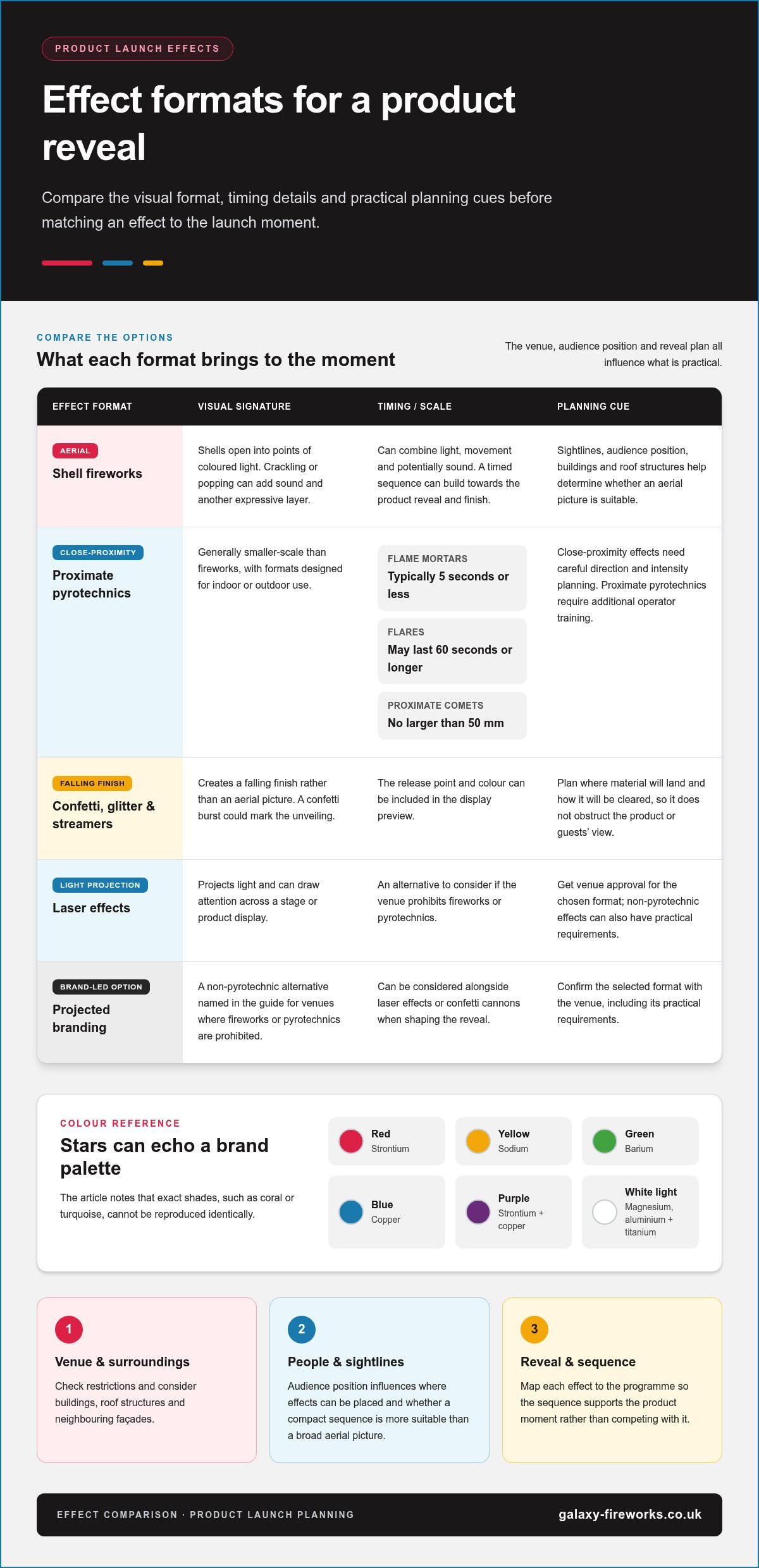
If a venue prohibits fireworks or pyrotechnics, consider alternatives such as projected branding, laser effects or confetti cannons. Get the venue’s approval for the chosen format, since non-pyrotechnic effects can also have practical requirements. For wider staging, lighting and technical solutions across live presentations, production firms like Straight Street Event Services demonstrate how to build an engaging atmosphere without pyrotechnics.
Confined urban sites call for careful planning around buildings, roof structures, neighbouring façades and the audience. These factors determine whether a rooftop display is feasible and where effects can be positioned. A compact sequence may suit a product reveal better than a broad aerial picture, especially when guests are close to the launch area. Firework colours can reflect a brand palette, but exact shades such as coral or turquoise cannot be reproduced identically.
Stars, light and sound effects
Stars are small pellets inside firework shells that create points of light and colour when the shell opens. Their palette can echo brand colours: strontium produces red, sodium yellow, barium green and copper blue. Strontium and copper together produce purple; magnesium, aluminium and titanium produce white light. Crackling or popping effects add sound and another expressive layer to the sequence.
Close-proximity effects suit moments that need controlled direction and intensity. Proximate pyrotechnics are generally smaller-scale than fireworks and can be designed for indoor or outdoor use. Examples include flame mortars, which typically last 5 seconds or less, and flares, which may last 60 seconds or longer. Proximate comets are no larger than 50 mm. Their different formats help shape the timing and visual rhythm of a reveal.
Confetti, glitter and streamers create a falling finish rather than an aerial picture. A confetti burst could mark the unveiling, while a laser effect draws attention across a stage or product display. Plan where material will land and how it will be cleared, so it does not obstruct the product or guests’ view. Include the effect’s colour and release point in the preview.
Comparing pyrotechnics with other effects
Pyrotechnics combine light, movement and potentially sound; cold sparks, confetti cannons and laser effects create different visual formats. That distinction matters when matching an effect to the reveal: shells open into coloured stars, confetti falls through the audience’s view, and lasers project light. A brief for pyrotechnics for product launches should state the intended look, venue restrictions and audience position before selecting the effect.
Operator qualifications and insurance
For a corporate celebration, the operator’s experience, safety planning and insurance matter as much as the visual effect. These details shape how the display is prepared and how the audience is protected.
Hiring a licensed pyrotechnician
For a UK product launch, engage a professional pyrotechnician with relevant training and experience for the planned effects. Professional firework displays are typically organised by licensed pyrotechnicians who follow safety guidelines. Ask the operator to explain their qualifications, experience with comparable venues, and how they will manage the display’s height, direction and proximity to the public.
Proximate pyrotechnics require additional training beyond other professional pyrotechnics areas. If your launch includes close-proximity effects, ask the operator to explain their specific experience and how it shapes the proposed layout. A clear explanation should connect the effect to audience position, the stage plan and its intended moment in the programme.
Discuss responsibilities before agreeing on the event plan. Establish who coordinates with the venue, who controls access to the firing area and who communicates changes on the day. If the audience layout changes, for example, the operator needs to understand how that affects the agreed positions and safety arrangements.
Insurance and risk assessments
A risk assessment identifies hazards, who could be affected and the measures planned to control each risk. For a launch, this means considering the firing area, audience routes, nearby structures, operator access, and the effects’ height and direction. Ask the operator to explain how the assessment relates to the actual venue rather than relying on a generic event description.
Public liability insurance concerns claims from third parties, such as members of the public, following injury or property damage. Review the operator’s insurance documentation and establish that the cover applies to the planned activity and event setting. Appropriate cover depends on the work and circumstances. An insurance certificate is not a substitute for a site-specific risk assessment.
Use planning discussions to check how the paperwork connects to practical arrangements. Clarify how the operator will keep the public away from the firing area, manage access during preparation and respond if the agreed layout changes. The venue’s restrictions and proposed effects should be consistent across the risk assessment and event plan.
Record the agreed roles, site arrangements and communication route in the event plan. That gives the organiser, venue team and pyrotechnician a shared reference for the celebration. If you’re shaping the display concept alongside these safety considerations, explore fireworks planning for corporate events as a related option.
Booking lead times and suitable venues
Plan the venue before finalising the display concept. Event organisers are advised to book professional fireworks 3 to 6 months in advance, allowing time to assess the site, coordinate permissions and align the effects with the launch programme.
Venue suitability can affect the display’s scale and format, so allow time to assess the site. A large open space may allow a broader layout, while a confined urban location can limit positions and sightlines. A product reveal beside a city-centre building, for example, needs a different site assessment from one in an open event space.
Professional fireworks displays typically take an entire day to set up. Include this on-site preparation in the event schedule, along with access arrangements and time to clear the area afterwards. A programme with an indoor presentation followed by an outdoor display also needs a workable transition between the two settings.
For a city rooftop, assess the building and surrounding area before committing to the concept. Feasibility depends on the roof structure, neighbouring façades and audience. With the owner’s consent, arrange a site visit and survey, and obtain opinions from the municipality and competent authority. These factors help establish whether the rooftop can accommodate the proposed display.
Permissions are part of corporate event planning. Organisers should obtain the necessary permissions from local councils and relevant authorities. Build this into the booking process, since the proposed site and display design determine which permissions and practical arrangements apply.
- Check the venue layout: map the audience area, access routes, structures and available display positions.
- Match the effects to the site: a restricted area may call for a more compact concept than a larger open venue.
- Coordinate the programme: mark the product reveal, display start and audience movement in the event schedule.
- Allow for set-up: reserve the full day typically needed for a professional display.
Indoor venues need a close fit between the room, planned effects and event format. Pyrotechnics are not interchangeable: effect type, direction and proximity all influence how a concept works in a particular space. If a venue’s restrictions rule out the intended effects, revise the display concept rather than assuming the venue is suitable.
For a combined indoor and outdoor launch, plan both settings as parts of one event. An indoor product presentation can lead into an outdoor display, for example, if the venue layout, audience movement and permissions support that sequence. Book early enough to develop the site plan, programme and display design together.
How much does professional event pyrotechnics cost in the UK?
There is no single useful price for a UK corporate fireworks display: cost depends on the event’s scale, effects and site requirements. A compact sequence for one product reveal has different production needs from a larger display planned as the finale to a corporate event.
Duration is one key planning factor. An event display is advised to last between 10 and 16 minutes, but the length alone doesn’t determine its cost. The number and type of effects, their sequence, and how they relate to the launch programme all influence the production plan. For example, a short, timed burst at the reveal calls for a different sequence from a display with several distinct moments.
Site conditions affect the work involved. A venue with straightforward access and a suitable display area presents different planning demands from a restricted city-centre site. Rooftop feasibility depends on the building, roof structure, neighbouring façades and audience. These details can affect the site plan, equipment access and the effects that can be used.
Timing also shapes production arrangements. Professional displays typically take an entire day to set up, so the schedule needs to account for site access and preparation. If the launch combines an indoor presentation with an outdoor display, the plan must also consider how guests move between spaces and when the reveal takes place.
To compare proposals, give each operator the same event information: venue, audience layout, product-reveal timing, desired visual style and any indoor or outdoor elements. Then compare what each proposal includes, such as the effect sequence, set-up arrangements and site planning. A proposal for a short finale is not equivalent to one covering several coordinated moments.
- Define the moment: identify whether the display marks the reveal, closes the event or punctuates several programme points.
- Describe the site: share the venue layout, access conditions and audience position.
- Set the visual brief: explain the colour palette and the balance of light, sound and scale.
- Review the plan: compare the proposed sequence and practical arrangements against your event schedule.
A product launch at a restricted urban venue may need a more tailored plan than an event in a larger open space. The deciding factors are the display design and site, not simply the event’s label. A clear brief lets organisers weigh production requirements against the impact they want for the launch.
How do pyrotechnics compare with cold sparks, confetti cannons and laser effects?
Choose according to the visual moment you want, rather than treating these effects as interchangeable. Fireworks can create a broad, vivid display; cold sparks offer a spark-like visual; confetti cannons send material into the air; and lasers project light. For a product reveal, the right choice depends on the venue, audience position and impression you want to create.
Pyrotechnics suit a launch that calls for dramatic visual punctuation, such as marking the reveal or closing a corporate event. Different effects can bring colour, movement and sound, while their direction and height shape the picture. The site layout matters: an outdoor space may support a different concept from a restricted indoor venue. Plan the effect around the event’s focal point, not simply the available space.
Cold sparks create a spark-like moment as a visual alternative to a firework burst. Confetti cannons create a distinct falling finish that can frame a product unveiling. Consider where the material will land and how it will be cleared afterwards. Confetti released above a stage, for example, may affect the product display, walkways or guests’ view. A laser effect uses projected light to carry a brand colour or graphic across a surface.
Compare the options against the same launch brief. If the priority is a striking burst, pyrotechnics may suit the desired mood. If the reveal needs a shower of material, consider confetti. If you want a visual projected or repeated across a surface, lasers offer a different format. Cold sparks provide a spark-like look without the same visual scale as an outdoor fireworks display. Venue rules and audience placement still determine which effects are suitable.
- Pyrotechnics: consider them for a bold, timed display that can combine colour, movement and sound.
- Cold sparks: use the spark-like appearance as the central visual idea in the launch sequence.
- Confetti cannons: plan the release point, falling material and clean-up around the product and audience.
- Laser effects: consider how projected light can highlight a brand mark, stage or product surface.
A combined approach can use one effect for the reveal and another for the event’s finale, provided the venue plan accommodates both. For instance, projected light could introduce a brand motif before a separate outdoor display. Keep the sequence purposeful: each effect should add something distinct rather than compete for attention. To explore fireworks options for a corporate event, view corporate fireworks options.
1St Galaxy Fireworks: Single Ignition Barrages
1st Galaxy Fireworks offers Single Ignition Barrages for organisers considering a straightforward barrage option for a product launch. They can be a useful starting point when you’re comparing a focused fireworks moment with a broader event display. For a different approach, the range also includes Pro Barrages, Cake Barrages and Discounted Display Packs.
Match your selection to the event brief: consider where the fireworks fit in the programme, the venue layout and the intended visual impact. For a larger corporate event, compare the available barrage categories with the role you want the display to play. Keep venue rules and safety planning central to the decision.
To explore the options, contact 1st Galaxy Fireworks or visit galaxy-fireworks.co.uk.
Shape your launch into a memorable moment
Turn your visual preview into a concise creative brief: identify the product reveal, the mood you want to create and the role fireworks should play. Planning pyrotechnics for product launches this way keeps the display connected to the brand and gives the event team a shared direction. A clear concept also helps you decide whether the effect should punctuate the reveal or close the event.
For a consumer-fireworks option, 1st Galaxy Fireworks offers Single Ignition Barrages, Pro Barrages and Cake Barrages. Consider which category best suits the atmosphere and place you have in mind, alongside the venue’s requirements. The right choice is the one that supports the experience you want your guests to remember.
When you’re ready to explore those options for your launch, contact 1st Galaxy Fireworks. Your next product reveal can begin with a clear idea and a confident plan.
Frequently Asked Questions
How can I show the client what the display will look like beforehand?
Present a storyboard that maps the display sequence to the product reveal, music cues and audience sightlines. Use annotated venue plans, reference images and colour swatches to make the intended atmosphere tangible. Show where the opening effect appears in the audience’s view, then illustrate how the finale frames the product. Treat the visuals as a concept preview, not a frame-by-frame guarantee of the finished display.
How do you match fireworks to a brand’s exact colours?
Choose the closest available firework colours and use the brand palette to guide the overall design. Exact shades such as coral or turquoise cannot be reproduced identically, so avoid promising a precise colour match. A useful brief identifies the main brand colours, preferred contrast and shades to avoid. Use the closest available colour for key moments, for example, then carry the exact brand shade through graphics or stage lighting.
What types of pyrotechnics are used at product launches?
Product launches can use fireworks such as barrages, rockets, mines and fountains, alongside close-proximity effects designed for more controlled visual moments. Examples include flame mortars, flares and comets. The effect choice shapes the look and timing: a barrage can create a sequence, whilst a fountain offers a different visual format. For consumer fireworks, 1st Galaxy Fireworks offers Single Ignition Barrages, Pro Barrages and Cake Barrages.
What licences and permits are required for pyrotechnics at a UK product launch?
Professional displays are typically organised by licensed pyrotechnicians, and corporate organisers should obtain necessary permissions from local councils and relevant authorities. The Pyrotechnic Articles (Safety) Regulations 2015 apply across the UK, with some modifications for Northern Ireland; regulation 33 sets out especially dangerous articles. These points concern different parts of planning: operator competence, event permissions and the articles involved. The venue and proposed display inform the permissions process.
What UK fire safety rules apply to indoor and outdoor event fireworks?
The Pyrotechnic Articles (Safety) Regulations 2015 apply across the UK, with some modifications for Northern Ireland, and regulation 33 sets out especially dangerous pyrotechnic articles. For event planning, indoor and outdoor settings require different site arrangements. A risk assessment should account for the room or open area, audience position, nearby structures and the planned effects. Venue restrictions and the display layout should inform the event’s fire-safety arrangements.
How far must fireworks and special effects be kept from guests, buildings and roads?
No single separation distance suits every firework and venue. The required layout depends on the effect, its height and direction, audience position, nearby buildings and road locations. A site plan should show the firing area, guest spaces, access routes and surrounding structures together. A confined urban venue, for example, needs a different layout from an open site. The operator’s site-specific assessment should set the arrangement for the display.
What information should an event pyrotechnics risk assessment include?
Include the venue layout, planned effects, firing area, audience positions, access routes and nearby buildings. Record the hazards, who could be affected and the controls planned for each one. Show how the public will be kept separate from the firing area and how the team will manage access during preparation. The assessment should reflect the actual site, with agreed arrangements updated if the event layout changes.
What are the main safety risks and insurance requirements for event pyrotechnics?
Key risks include injury to guests or crew and property damage, particularly if the firing area, audience layout or access arrangements are not managed. Public liability insurance relates to third-party claims, including injury or property damage. Treat insurance documentation and the event risk assessment as separate parts of planning: the assessment describes site hazards and controls, while insurance relates to liability. The event plan should connect the effects, venue layout and safety arrangements.
